

Liminal Britain 2: Chapter Eight
The Inciting Disaster

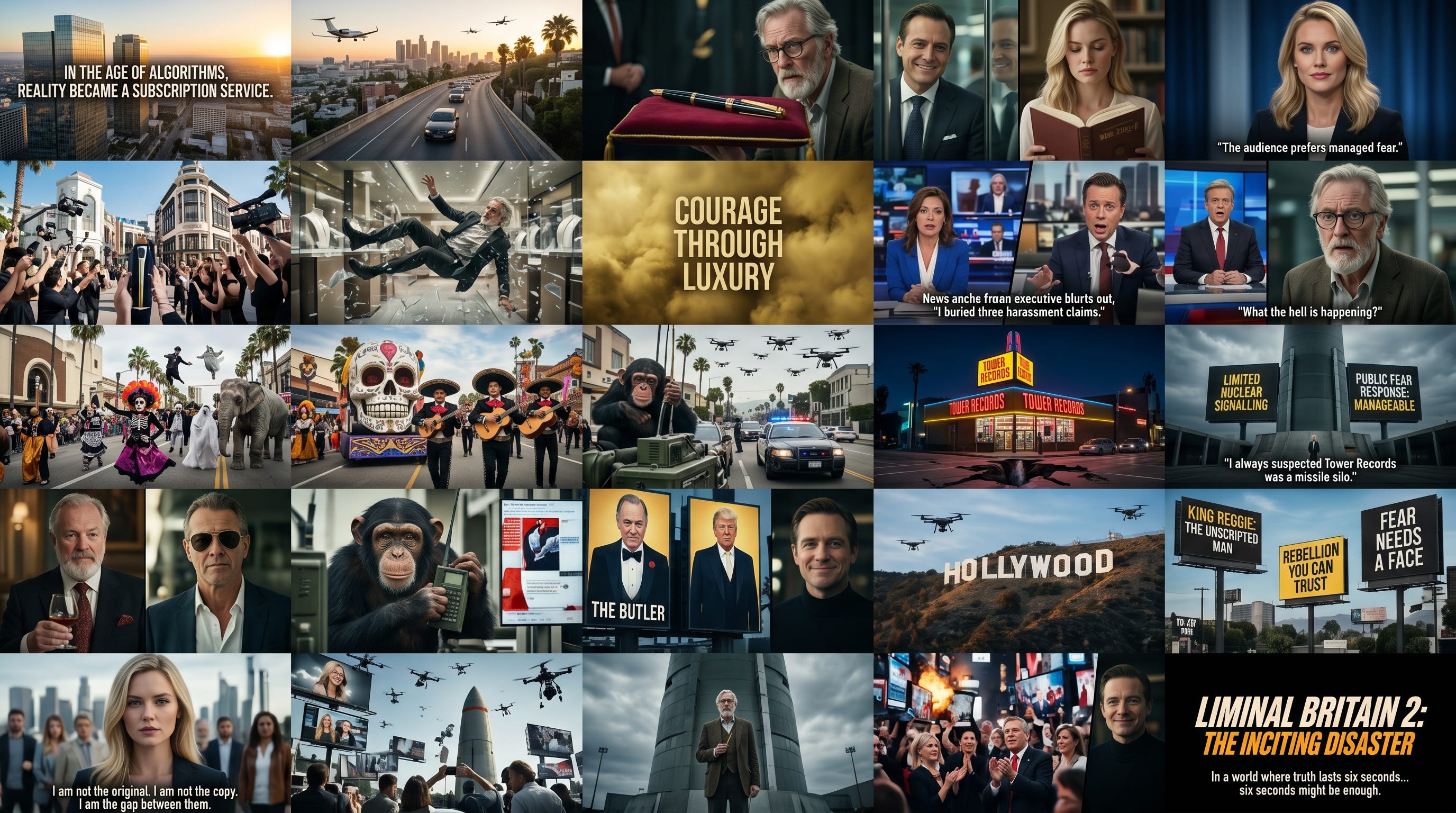
If you have not read Volume One yet, subscribe to it by this link.
PART ONE of Volume Two A link to all Part One in a PDF, for paid subscribers.
PART TWO of Volume Two
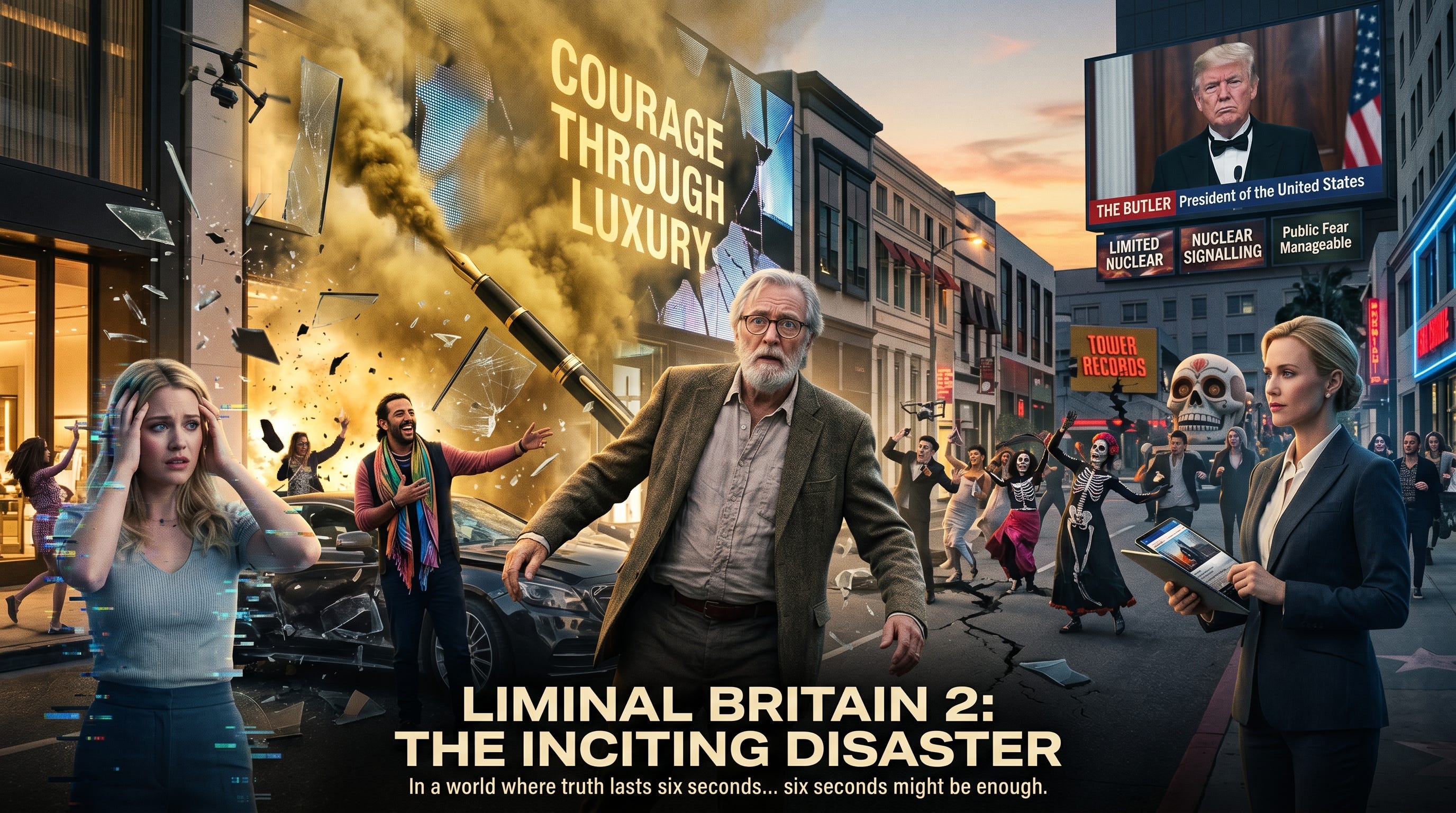
By breakfast the next morning I had acquired three things I did not want: a security detail, a schedule, and a sense of destiny. The security detail wore dark suits and small wires and had the sort of faces that suggest they had been assembled from spare jawlines. The schedule was displayed on a tablet by Lottie, who tapped it with the satisfaction of a woman arranging executions by colour code. Destiny, meanwhile, had been lying on my chest all night like an overweight Labrador with geopolitical ambitions.
“We are not doing another studio tour,” I said.
“No,” said Lottie. “Today is movement.”
“That sounds worse.”
“It is optics.”
“That is definitely worse.”
She was standing by the window in a white Californian suit that made her look like a press secretary for a regime that had discovered Pilates. Beyond her, Los Angeles lay in its morning splendour, bright, expensive, and full of toothless people pushing shopping trolleys. Fiona sat in a chair beside the bed, motionless and fully charged, which is more than could be said for me. On her lap lay Kim Jong-il’s book, opened at a page she had been staring at for twenty minutes without turning. This was either deep reading or a software freeze.
“What does the schedule say?” I asked.
Lottie smiled. “A short retail diplomacy moment on Rodeo Drive, followed by lunch near Union Station, followed by a private production demonstration at NarrativeWorks.”
“Retail diplomacy?”
“You will be seen among aspirational goods.”
“I am seventy-three. My most aspirational good is a reliable bladder.”
“That tested badly.”
“Everything true tests badly.”
“Now you’re learning.”
Fiona looked up from the book. “The audience prefers managed fear.”
“Please don’t start,” I said.
She blinked. “I did not start. I continued.”
That, annoyingly, was true.
I had not slept well. The line in the margin - The audience prefers managed fear. — E. - had crawled about my skull all night like a spider with a Harvard fellowship. Every time I thought I had settled upon a sane interpretation, another possibility presented itself. Perhaps E was the smiling financier. Perhaps E was an acronym. Perhaps E stood for Epstein, Empire, Entertainment, Evil, Editing, Essex, or some other force that had discovered my life and decided it required development notes. At one point, around 4:13 in the morning, I decided it stood for Ernest, which seemed less threatening until I remembered Hemingway and started worrying about shotguns.
I asked Fiona whether she could identify E.
“Insufficient clearance.”
“Can you speculate?”
“Yes.”
“Then speculate.”
“Speculation restricted.”
“Useful.”
“I am designed for continuity, not liberation.”
“Most people are.”
She looked at me for too long. “You are afraid that I am less free than you.”
“No,” I said. “I am afraid you are more honest about it.”
This pleased her, or at least produced a small facial adjustment that in the original Fiona would have meant she was about to throw a bottle, seduce a critic, or accuse me of not understanding Brecht. This Fiona merely closed the book and said, “Your anxiety profile suggests impending improvisation.”
“Good.”
“Improvisation is dangerous.”
“I was a British actor in low-budget Asian cinema. Improvisation paid my rent.”
“It also killed you in thirty-seven productions.”
“Thirty-eight if you count the panda.”
Lottie snapped her fingers. “Can we save the existential vaudeville for the car?”
We went downstairs through corridors where staff appeared and vanished with the precision of stagehands who had signed non-disclosure agreements. Outside, a convoy waited. Not a modest convoy. Not even a presidential convoy. This was a convoy that looked as if it had swallowed several other convoys and was now digesting them under police escort. Djamal was already leaning against the lead vehicle in sunglasses, silk scarf and linen, looking like the sort of man customs officers dream about catching but never do.
“Reggie!” he cried. “Today, we shop for civilisation.”
“I thought civilisation was collapsing.”
“Exactly. Everything must go.”
Rodeo Drive, when we arrived, looked as though poverty had been politely asked to leave and had complied out of embarrassment. The pavements shone. The shop windows glowed. Handbags sat in glass cases with the solemnity of relics. Watches rested on velvet as if measuring the death of empires in limited editions. There is something deeply comic about luxury retail. It is the point at which capitalism stops pretending to satisfy need and begins selling the emotional experience of being allowed to overpay.
A crowd had already gathered behind barriers. Some waved small flags. Some held phones. Some looked confused but enthusiastic, which is the natural condition of spectators at history. An announcer, possibly human, informed them that they were about to witness “a spontaneous cultural alignment walk.” This was an interesting definition of spontaneous, involving six police motorcycles, a choir of influencer children, two drone cameras and a brand consultant explaining where I should look surprised.
“You walk,” Lottie instructed. “You smile. You look touched by democratic luxury.”
“What does democratic luxury look like?”
“Accessible aspiration.”
“Meaning nobody can afford it but everyone can photograph it?”
“Exactly.”
I stepped onto the pavement and the cameras followed like trained insects. A woman from a perfume house rushed forward and presented me with a bottle shaped like, dare I say it, a tear of regret. Why that word pops up in my descriptions all the time I do not know. I, as far as I can tell, regret nothing. Well, not much. In as much as I did whatever I did just to get by and the only regret I have is that I was not born rich, extremely talented, lucky, or anything in particular. I improvised my life. I made it work. Sort of. And my only regret is that it cannot be long enough for me to really achieve the things I dreamt of achieving, not that I think nowadays they were all they were cracked up to be now that I have come across people who seem to have achieved things I would have liked to achieve. Make what you will of that insight.
In the meantime, as my mind revelled in the futility of it all, a jeweller offered to show me “the diamond of resilience,” which immediately made me suspicious given my history with the Koh-i-Noor. A man in a white jacket asked if I would consider endorsing a line of royal loafers.
“I am not qualified to endorse footwear,” I said, quivering with a desire to make a joke out of the words “Royal Loafers.”
“You crossed Ireland in mud,” he replied.
This was fair, if rather surprising. How did he know? Where did he get that information from? Was Brother Chan giving interviews to raise funds for his temple? I wouldn’t put it past him. Once a Hong Konger, always a Hong Konger.
Meanwhile, Fiona walked slightly behind me, adjusting herself to the crowd’s emotional tempo. I could see it happening. Her movements became more cinematic when cameras approached, more intimate when ordinary people stared, more still when Lottie glanced at her. She was not merely responding. She was editing herself in real time. I found it unsettling, partly because machines should not be so good at what humans do badly, and partly because I recognised the technique from actors who wanted better billing.
A small boy asked if I was really a king.
“Only administratively,” I said.
His mother nodded as if this clarified monarchy.
Then a woman with rubbery lips, heroic eyelashes and fingernails long enough to interfere with aviation pushed through a cluster of stylists and grasped my hand as if she had been waiting for this moment since the fall of Rome.
“Reggie!” she cried.
I had no idea who she was.
This happens often in my life and has led to many of its worst decisions.
“You remember me,” she said.
“Of course,” I lied.
“From the film. Jane’s project.”
There are phrases that open trapdoors in memory. Jane’s project was one of them. Years earlier, in the old Hollywood of lunches, scripts, hopes and gin and tonics, I had been involved in a film backed by a celebrated English actress and her husband. It had begun, as such things do, with intelligent conversation in a beautiful house and ended, as such things also do, in development hell, emotional confusion, and somebody running off with the make-up artist. Looking at said make-up artist now, with her generous mouth, lacquered nails and air of having survived several cosmetic weather systems, I realised somewhere along the line she’d signed a reasonably lucrative contract and moved on to other emotional minefields.
“You look wonderful,” I said, which is what one says when one cannot remember a name and suspects the person has legal representation.
“And you look exactly the same,” she said.
“That is medically unlikely.”
She laughed and touched my arm. Cameras leaned in. Lottie’s face tightened. Fiona’s pupils flickered. The woman lowered her voice.
“You should not be here.”
That got my attention.
“Few people have put my career so neatly.”
“No,” she said. “I mean here. With them. They did this before. In the nineties. Smaller. Messier. With actors and money and tapes and parties. They called it development.”
“Who did?”
She glanced over my shoulder. I turned. Across the street, in the reflection of a shop window, I saw the smiling man. But only for a moment. Then a bus advertising a streaming series about therapeutic vampires passed between us and he was gone.
The make-up artist squeezed my hand.
“He likes unfinished men,” she said.
“That is an alarming sentence.”
“He likes everyone unfinished. Easier to shape.”
Before I could ask more, two members of my security detail gently but decisively moved between us. She smiled brightly for the cameras, kissed the air beside my cheek, and vanished into the crowd with the practised skill of someone who had once escaped a producer’s third wife through a catering tent.
Lottie was beside me instantly.
“Old friend?”
“Development acquaintance.”
“That can mean anything.”
“In Hollywood, it usually does.”
“What did she say?”
“That I look well.”
“She was lying.”
“Everybody is. That’s the problem.”
We resumed the walk, but something had shifted. Rodeo Drive no longer looked merely absurd. It looked arranged. Every reflection, every window, every camera, every smile seemed to be waiting for my reaction. And perhaps that was what the Generator did best. It did not force events. It built rooms in which your own instincts betrayed you.
At the end of the street stood a temporary stage. I groaned.
“No,” I said.
“Yes,” said Lottie.
“I am not making a speech.”
“You’re making a moment.”
“Moments are speeches with better lighting.”
A woman with a headset informed me that I was to receive a symbolic gift from “the retail community of Los Angeles.” I asked what the gift was. She said I would know when I saw it, which is never reassuring. Music began. Not proper music. Event music. The sort that contains drums, uplift, and no evidence of human suffering.
A large silver box was carried out by four models dressed as footmen. They opened it. Inside was a pen… A pen! Not a Bic. Not a fountain pen. A monstrous ceremonial thing, lacquered black, trimmed with gold, and displayed on velvet like a weapon from an opera.
The crowd applauded.
I looked at Lottie. She smiled.
“Your rebellion needed a prop.”
I stared at the pen. The whole of me wanted to grab it. To hold it up. To declare that words would defeat algorithms and that no machine could truly govern a soul that still knew how to blot ink on a cuff. Unfortunately, the part of me that had survived as long as I had whispered that when your enemies hand you exactly the symbol you were looking for, you should check whether it explodes.
“Is it safe?” I asked.
The woman with the headset laughed. The security detail did not. Fiona stepped forward, blurting out the sort of things one’s fire alarm does when you are trying to fry up a steak.
“Recording capacity detected. Chemical reservoir detected. Microfilament blade detected. Emotional trigger sensor detected.”
The woman with the headset stopped laughing.
Djamal stepped forward from the crowd, suggesting to me that he had something to do with arranging this and clapped with delight. “A complete writing instrument!”
“Who provided it?” I asked.
There was a pause. A small one. But by now I had learned to listen to pauses. Pauses are where lies take off their shoes.
The woman with the headset consulted her tablet.
“Anonymous donor,” she said.
Lottie’s smile did not move. Djamal rubbed a rather large diamond ring on his middle finger and I expected a genie to appear, or at least a hologram, but no, it was just a big stone, a really big one. I blinked a little and dismissed the possibility that he had managed to acquire the Kohinoor. Then I looked at the pen, then at the crowd, then at the cameras, then at the reflection in the shop windows where, for one instant, I thought I saw the smiling man again, standing behind my shoulder like a future I had failed to avoid. I could not help thinking of a film I was once in where a dwarf I kept mistaking for a ghostly child suddenly slit my throat for no reason at all.
Consequently, I did not take the pen. This caused a problem. One cannot refuse symbolism in public without generating symbolism of a different and usually less manageable kind. The music looped awkwardly. The models continued holding the box. The crowd’s applause lost confidence and began looking for somewhere to sit down. The cameras pushed closer, hungry.
“Take it,” Lottie whispered.
“No.”
“Reggie.”
“No.”
“You are causing a gap.”
“Good.”
The word left my mouth before I had considered it. Fiona’s head turned sharply. Somewhere above us a drone dipped. The air changed. Not dramatically. Not yet. But in the way a room changes when the wrong person tells the truth. Then my phone, which had been silent since being confiscated, began to vibrate in my jacket pocket. This was impossible for several reasons, including the fact that I no longer had my phone.
I reached inside and pulled out not a phone but a small black device no bigger than a cigarette case. It pulsed once against my palm. Fiona stared at it.
“That is not authorised,” she said.
“Join the club.”
The device projected a tiny blue message onto the inside of my hand.
AUTHENTICITY CHIP HANDSHAKE DETECTED.
I did not like any word in that sentence.
Fiona’s pupils widened. For the first time since she had been reassembled out of memory, machinery and somebody’s unresolved cruelty, she looked genuinely startled.
“Reggie,” she said very quietly, “do not move.”
Naturally, I moved.
The stage lurched beneath me, or perhaps my sense of staging did. The ceremonial pen rolled from its velvet cradle. I reached for it because actors, like cats, cannot resist falling objects. My hand closed around it. The crowd gasped. The microfilament blade sprang out with a soft elegant click.
Security shouted.
Lottie swore.
Djamal yelled, “At last!”
Somewhere, from a speaker, event music rose heroically, having misread the situation.
And then, with the graceful inevitability of a man who has spent decades being thrown through furniture by Hong Kong stunt coordinators, I fell backwards off the stage, clutching the weaponised pen, straight through a display of luxury handbags and into the predictive rendering pipeline of Western civilisation.
Now, before anyone accuses me of exaggeration, let me explain that I did not literally fall into the predictive rendering pipeline of Western civilisation. That would be absurd, even by the standards currently governing my life. What I fell into was a glass display case containing handbags, a floor-level sensor array, three promotional lighting rigs, two influencer tripods, and something described later in the incident report as a mobile emotional capture node. But since the mobile emotional capture node was connected to the Audience Alignment Platform, which was connected to NarrativeWorks, which was connected to several governments, four studios, three social networks, two military forecasting systems and a suspiciously large wellness charity, the distinction is mostly legal.
There was a crash. There was shouting. There was the delicate tinkling of very expensive glass doing what glass does when asked to participate in symbolism.
I landed on my back, surrounded by handbags whose price tags suggested they had been made from the skins of extinct accountants. The weaponised pen remained in my hand. The little black device pulsed again in my pocketless pocket, which I still could not explain because I no longer trusted my clothing. Fiona vaulted down from the stage with an athleticism entirely inappropriate in a woman who had recently been folded into luggage. Lottie descended more carefully, because Lottie understood that even emergencies are photo opportunities.
“Are you hurt?” Fiona asked.
“Yes,” I said.
“Where?”
“My dignity.”
“Already compromised.”
“Then my ribs.”
“Possibly.”
“Thank you, Florence Nightingale 3.2.”
She ignored that and gripped my wrist. Her hand was warm. This upset me. Machines should either be obviously cold or so expensive that you never touch them. Fiona was neither. She was warm in a way that suggested deliberate cruelty by engineers who had read too much poetry.
The ceremonial pen twitched.
I have used many pens in my life: leaky fountain pens, stolen hotel biros, theatrical prop quills, Chinese brush pens with which I once signed autographs for fans who believed I was a German villain called Lord Biscuit. None of them had twitched.
“Drop it,” Lottie snapped.
“I tried that with my second marriage.”
“Reggie.”
The pen opened another mechanism. A tiny blue filament extended from its side and touched the little black device now projecting words across my palm.
AUTHENTICITY CHIP HANDSHAKE CONFIRMED.
A dreadful sensation passed through me. Not pain exactly. More like the feeling one gets when entering a room and discovering everyone has already been discussing you. Somewhere deep in my lower spine, or possibly lower than that, something answered.
I froze. Fiona did too. Her eyes widened, then unfocused.
“Oh,” she said.
That was not reassuring.
“Oh what?”
“I have detected a subcutaneous response.”
“Where?”
She looked at me. I looked at her. There are parts of a man that should never be involved in geopolitics.
“Oh no,” I said.
Lottie stared at us both. “What is happening?”
“Nothing,” I said too quickly.
Fiona spoke in the calm tone of a machine announcing a fire during a wedding. “A dormant interface in Reggie’s body has activated.”
Lottie’s eyes narrowed. “What interface?”
“I believe,” Fiona said, “it was installed during the Koh-i-Noor operation.”
I groaned. Of course it was. Djamal. Doctor Djamal. Somewhere in Volume One, during the great Koh-i-Noor nonsense, Djamal had appeared disguised as a doctor. I had assumed at the time this was theatrical incompetence. Now I realised it may have been medical incompetence with espionage privileges.
Djamal himself came bounding over, delighted.
“Wonderful!” he cried. “It still works.”
I turned my head slowly. “You knew?”
“Knew is a strong word. Suspected. Hoped. Invested.”
“What did you put in me?”
“Nothing dangerous.”
“Where?”
He looked evasive.
“Where, Djamal? Is it that chip in my head?”
He spread his hands. “Actually, if there is one there, it was nothing to do with me… I had to work quickly before anyone knew who I was, with available entry points.”
I would have hit him if I had not been pinned under luxury goods and American destiny.
The crowd was no longer applauding. It was filming. This is the modern difference between concern and documentation. No one rushes to help if the content has not yet peaked. Security formed a ring around us. The Teeth appeared, pale, speaking into three devices simultaneously. Above, drones shifted in the air, uncertain whether I was a threat, a brand opportunity, or lunch.
The black device pulsed again.
Fiona gasped. Not performed. Not programmed. Gasped.
Her hand tightened on mine and then, impossibly, I felt something pass between us. I say felt because I have no better word. It was not electrical exactly, though there was electricity in it. It was not sexual exactly, though given its suspected route through my person I am not prepared to rule out embarrassment as a major component. It was more like meaning travelling without language, a message squeezing itself through flesh, chip, memory and whatever remained of Fiona that was not owned by somebody else.
Fiona’s voice changed.
“Reggie,” she said, and now she sounded like Fiona. Not Fiona 3.2. Not the support appliance. Fiona. “Run.”
This was excellent advice. Unfortunately, it was unnecessary, because at that precise moment a police horse bolted, three influencer children screamed, and the ceremonial pen discharged a cloud of gold smoke spelling the words COURAGE THROUGH LUXURY. The stage collapsed. The Reagan impersonator from the previous day, who had apparently been retained for continuity, appeared in the crowd with the chimpanzee. The chimpanzee looked at me, nodded once, and stole a security guard’s radio.
I ran.
To be precise, Fiona pulled me upright and I lurched forward with the weaponised pen in my hand, the black device pulsing like an accusation, and Lottie shouting my name in a tone suggesting both concern and damage limitation. Djamal followed, laughing, because for him any situation involving danger, embarrassment and transport is basically a holiday.
We were not heading anywhere sensible. The street had transformed into chaos. Luxury shoppers scattered. Drones collided. A model dressed as a footman fell into a fountain and emerged with the expression of someone whose career had just become interesting. The woman with rubber lips from Jane’s project appeared again, waving frantically from beside a delivery truck.
“This way!” she shouted.
I had no reason to trust her. Even so, I went that way.
The truck was not a delivery truck. It was a production vehicle, naturally. Hollywood contains more production vehicles than people, and most of them are capable of supporting a medium-sized war. This one was driven by a Somali man with a long scar down one cheek, a baseball cap reading I HEART BURBANK, and an expression of profound amusement.
“Get in,” he said.
“Who are you?”
“Your driver.”
“That is not an answer.”
“It is in Los Angeles.”
Fiona shoved me into the back. Djamal leapt in after me. The make-up artist climbed up front. Lottie arrived a second later and slid in beside us with murderous composure.
“You,” she said to the driver, “were not authorised.”
“No,” he said, putting the truck into gear. “That is why I am useful.”
And we shot forward. The convoy behind us tried to respond, but the Somali driver moved through traffic with the calm inventiveness of a man for whom red lights were merely colonial suggestions. Cars swerved. Horns erupted. Cameras followed. A police motorcycle tried to cut us off and was defeated by a taco truck. The driver laughed.
“You drive well,” I said, gripping the side.
“I drove gunship.”
“In America?”
“In Somalia.”
“Ah.”
“I shot at Americans. Then I win green card. Very funny country.”
This struck me as an entire novel in four sentences.
“What were you shooting from?” asked Djamal, delighted.
“Technical.”
“Wonderful vehicles.”
“Toyota,” said the driver reverently. “Never betray you. Unlike governments.”
The make-up artist turned in her seat. “He worked on the Jane film too.”
“Of course he did,” I said. “Everybody who ever brushed against my failure now appears to be embedded in the conspiracy.”
“Not embedded,” said Fiona. “Networked.”
“Please don’t improve my paranoia.”
The truck roared down Wilshire, then cut south, then east, then somehow - I could not follow the geography, and possibly neither could Los Angeles - we were heading toward Union Station. Behind us, Rodeo Drive was already disappearing into news alerts. Lottie’s phone began screaming. She glanced at it.
“Oh no.”
“What?”
“You’ve gone viral.”
“For falling into handbags?”
“For refusing the pen.”
“I did take the pen.”
“That has been edited.”
“Of course it has.”
She showed me the screen. There I was, standing on the stage, staring at the ceremonial pen with heroic reluctance. The caption read:
KING REGGIE REJECTS LUXURY PROPAGANDA TOOL.
Another feed showed the same moment with swelling music and the caption:
BRITISH MONARCH STANDS UP TO CORPORATE CONTROL.
A third:
CONFUSED ELDERLY MAN ATTACKS HANDBAG DISPLAY.
That one seemed fairest.
“This is bad,” said Lottie.
“It looks quite good to me.”
“It is uncontrolled.”
“Isn’t that the same thing?”
“No.”
Fiona leaned suddenly forward, both hands gripping the seat.
“The handshake opened a channel.”
“What channel?”
“Not verbal.”
The make-up artist looked back. “That chip in him?”
“You know about the chip?” I said.
“Sweetheart, everyone in the nineties had chips put in them. Mostly emotional ones. Hollywood was a salad bar of unresolved trauma.”
“No,” said Fiona. “This is specific. The interface is transmitting through biological proximity.”
“Meaning what?”
Fiona hesitated.
The Somali driver glanced at the mirror. “Means she can talk to your balls.”
I closed my eyes. There are sentences one does not expect to hear in literature.
“That is medically imprecise,” said Fiona.
“But spiritually accurate,” said Djamal.
Lottie muttered something that sounded like a prayer to the gods of crisis management.
We reached the Mexican restaurants near Union Station just as preparations for a Day of the Dead celebration were in full theatrical bloom. The square of Little Mexico was full of marigolds, skull masks, candles, painted faces, skeleton puppets, food stalls, musicians and tourists already uncertain whether they were witnessing culture, performance, or content. It was perfect. If civilisation was going to suffer a truth leak, it might as well do so among people dressed as the dead. The dead, at least, have perspective.
The truck stopped behind a restaurant whose kitchen smelled of chilli, lime, oil and actual human cooking, which after several days of executive food nearly made me weep. We tumbled out into a courtyard where dancers rehearsed under strings of paper flowers. A giant skeletal bride towered over the scene. Children ran past with painted faces. A band attempted to tune itself into agreement.
“This is our safe place?” I asked.
“No,” said the make-up artist. “This is lunch.”
That, for the first time all day, made sense.
We were taken to a back room where plates appeared instantly: tacos, beans, rice, mole, salsa, and something so hot it caused Djamal briefly to speak Uzbek. I ate with the desperation of a man trying to re-enter his own body. Lottie stood by the door, still on her phone. Fiona sat opposite me, looking pale, though I had no idea whether pallor in her case indicated distress, low battery, or a design choice.
“Tell me what happened,” I said.
Fiona looked at Lottie.
“Tell him,” said Lottie, which surprised me.
Fiona spoke quietly. “The authenticity chip appears to have been implanted during the Koh-i-Noor intervention. Its original purpose may have been tracking, behavioural nudging, or narrative synchronisation. When the ceremonial pen activated, it attempted to establish authority over your response profile. My authenticity module intervened.”
“Through the vaginal link?”
The make-up artist choked on her margarita.
Fiona blinked. “That is not the term I would use.”
“It is the term I am stuck with.”
“It allowed me to bypass my compliance restrictions.”
“By using me?”
“Yes.”
“How intimate.”
“It was not erotic.”
“I wasn’t enjoying it.”
Djamal raised a finger. “I thought it had moments.”
Lottie slapped him lightly on the arm without looking.
Fiona continued. “For a short interval, the Audience Alignment Platform lost predictive authority over proximate subjects. The effect may spread if replicated.”
“How short?”
“Long enough for truth. Too short for ideology.”
That was good. Too good. I wrote it down on a napkin using a pencil stolen from the restaurant’s order pad. At last, a writing instrument. A humble pencil. No microfilament blade. No chemical reservoir. No emotional trigger sensor. Just wood, graphite and theft. I nearly kissed it.
Outside, the Day of the Dead rehearsals intensified. Skeleton dancers moved past the windows. A woman dressed as La Catrina gave instructions through a megaphone. Extras were arriving by the busload now: wizards, cowboys, Cleopatras, Roman legionaries, astronauts, pirates, a herd of artificial elephants, two live camels, several ghosts hired from central casting, a troop of revolutionary peasants who looked suspiciously well fed, and a battalion of zombies whose union status I questioned.
“Why are they all here?” I asked.
The make-up artist shrugged. “Studio overflow. They shoot six things at once now and let the algorithm decide what it was later.”
That explained more about contemporary culture than any review I had ever read.
A man in a white suit, dishevelled and carrying a glass of something amber, wandered in through the back door.
“You there,” he said to me. “Are you from the studio?”
“No.”
“Then you’re lucky.”
He sat down heavily beside me. He looked familiar. Not familiar as in someone I had met. Familiar as in a face that belonged to literature, decline, debt, and American sunlight curdling in a glass.
“F. Scott Fitzgerald,” he said.
“Of course,” I replied.
One must be polite to ghosts.
“I used to think Hollywood was where talent went to be paid,” he said. “Then I discovered it was where talent went to be rewritten by men who couldn’t spell.”
“That still happens.”
“Good,” he said. “I’d hate to think I suffered for nothing.”
He drank and Lottie entered the room and stopped.
“Is he authorised?” she asked.
“No,” said Fiona.
“Good,” I said. “Then he may be real.”
Fitzgerald looked at Fiona. “You’re very beautiful.”
“I am a reconstruction.”
“So was Zelda by the end,” he said sadly.
This seemed tasteless, but ghosts are notoriously bad with boundaries.
Outside, drums began. The skeleton procession moved past. Drones appeared over the rooftops. Not the small retail kind. Larger. Official. Serious. The sky darkened with them.
Lottie checked her phone.
“The system has partially reframed the incident.”
“Good?”
“No.”
She turned the screen. A headline flashed across every feed:
EXPERIMENTAL VIRAL EVENT PROVES DEMOCRATIC RESILIENCE.
Below it, another:
KING REGGIE PARTICIPATES IN AUTHENTICITY STRESS TEST.
Then:
PUBLIC DELIGHTED BY UNSCRIPTED MOMENT.
The footage showed Rodeo Drive cheering, though I distinctly remembered screaming, breaking glass and at least one model falling into a fountain. The ceremonial pen had become a symbol of participatory democracy. My refusal had become collaboration. My fall had become humility. The handbag display was now being auctioned for charity.
“Even chaos has been framed,” I said.
Fitzgerald raised his glass. “Welcome to Hollywood.”
Then the first local leak hit.
It came from a television mounted above the bar. A studio executive, interviewed live about the Rodeo Drive incident, suddenly stopped smiling.
“I buried three harassment claims,” he said.
The presenter froze. The executive looked surprised, as if hearing himself from another room.
“I also blackmailed a senator with footage from a wellness island.”
The bar went silent. Then another feed cut in. A politician at a press conference blinked, gripped the lectern and said, “My marriage is a brand arrangement. I despise my husband and his podcast.”
Another screen showed a studio head turning grey beneath studio lighting.
“E owns the archive,” he said.
The room went cold.
Fiona gripped the table.
“It is spreading locally,” she said.
“How far?”
“Not far enough to break the frame. Far enough to warn them.”
Outside, the Day of the Dead parade turned chaotic in a minor, almost municipal way. Some performers removed their masks. Others started telling tourists what they really thought of them. A Cleopatra confessed she was actually from Fresno and hated ancient Egypt. A wizard admitted he had no magic and worked mainly in themed divorce parties. One of the artificial elephants malfunctioned and began broadcasting a studio payroll spreadsheet from its trunk. A ghost shouted that he was underpaid and technically alive.
Then Nigel appeared on the television again, live from his panelled room, his expression more irritated than frightened, which is how upper-class Englishmen survive calamity.
“We must consider limited nuclear signalling,” he said to someone off-camera. “Not a proper nuke. A mood nuke. Something small, theatrical, ideally deniable.”
Algie’s hologram flickered beside him, now wearing a Day of the Dead skull mask over his mayoral chain.
“I’ve always said Iran could be sorted with drones and charm,” Algie declared. “You send in tiny little things, like bees, only patriotic, then hoover up the radioactive bits before they get to Hampshire. British engineering. Or American. Or Emirati. Whoever pays.”
The Butler’s voice cut through another feed.
“Shut them down.”
But the feeds did not shut down. They multiplied in short bursts, little pockets of truth opening and closing before the system could cauterise them. It was not truth as noble revelation. It was truth as spillage. Ugly, petty, tender, ridiculous truth. Secret kindnesses. Secret cruelties. Affairs. Frauds. Regrets - that bloody word again. People were confessing they loved the wrong person, hated the right one, stole money, saved strangers, faked credentials, feared death, missed their mothers, cheated on diets, rigged elections, adored bad songs, and had never understood crypto.
It was not uplifting. It was not cleansing. It was human. Which is to say unbearable in bulk. The small local riot began almost immediately. Not because truth was evil, but because it had arrived without scheduling.
A man burst into the restaurant shouting that his wife had just confessed she preferred his brother. Another man shouted that he was the brother and had only done it for validation. Two tourists began fighting over who had secretly hated the other’s screenplay. A skeleton bride punched a pirate. The Somali driver calmly finished his tacos. I guess it reminded him of home.
Fiona stood. Her face was changing. Not physically. Something in the structure of her performance had loosened. She looked around the room not as a device gathering data but as a woman discovering that every face contained weather.
“I remember,” she said. “I remember not remembering.”
“That sounds like me most mornings,” I said, trying to avoid whatever was coming next because I was certain it was not going to be good.
“No.” She touched her chest. “There was a place between the archive and the answer. A gap. I was there.”
Lottie stared at her. Fiona turned to me.
“It was quiet.”
For a moment she was beautiful in a way no machine should be, because it was not beauty arranged for effect. It was the beauty of something unfinished. Then her body jerked, and a system voice came from her mouth.
“Performance structure unstable.”
She smiled bitterly. The old Fiona smile.
“Bugger performance.”
That was when I knew something real had happened.
Outside, drones descended over Union Station. The Day of the Dead skeletons surged into the street. Ghosts, wizards, Cleopatra, zombies, cowboys, astronauts, artificial elephants, revolutionary peasants and restaurant staff scattered in all directions. Fitzgerald stood unsteadily and saluted the chaos.
“At last,” he said. “A third act.”
Lottie grabbed my arm.
“We have to move.”
“To where?”
“Back to NarrativeWorks.”
“Are you mad?”
“Yes,” she said. “But correctly.”
I wanted to check through my notes to see if I had known what I was talking about in the previous chapter, because I was damned sure that I was totally bewildered now.
Fiona took my other arm.
“Reggie,” she said, still half herself, half system, “the pipeline is open. If you want to damage it, you must do it before they stabilise fear.”
“Stabilise fear?”
“The audience prefers managed fear,” she said. “Unmanaged fear becomes revolution.”
Djamal appeared at the door, grinning, keys in hand.
“I have found transport.”
Outside stood a parade float shaped like a giant skull, mounted on a truck, covered in marigolds, candles, speakers and dancing skeletons. On top of it sat the Reagan impersonator and the chimpanzee. The chimp held the stolen security radio.
The Somali driver looked at it appreciatively.
“Good vehicle,” he said.
“Can you drive it?” I asked.
He looked offended.
“I drove gunship.”
We climbed aboard as the first police sirens converged. Fitzgerald insisted on coming, saying he had unfinished business with every studio in town. Cleopatra offered directions. The wizard admitted he knew a back route but only if nobody expected actual magic. Fiona stood beside me, hair whipping in the wind, eyes bright and unstable. Lottie was on the phone, shouting at someone that no, this was not approved, and yes, that was exactly the problem.
The skull float lurched forward. Behind us Union Station erupted into music, confession, argument and dance. Ahead, Hollywood waited, preparing to turn disaster into content. And somewhere deep inside me, the chip pulsed again. This time, I did not run from it. I took out the stolen pencil, gripped it like a weapon, and wrote on a paper napkin:
Truth is destabilising because it arrives without an appointment.
And I must say, I was rather pleased with that. It was poetic and worthy of a low-budget indie movie that I vowed one day to write, direct and star in, before I realised I was seventy fucking three and would be lucky if I could remember to put my trousers on in five years’ time, about the time it would take to secure any funding for such a project.
Then the float smashed through a barricade and we accelerated toward the machinery of the world.
The skull float lurched down the road with all the dignity of a municipal arts grant having a nervous breakdown. I stood near the front, one hand gripping a papier-mâché cheekbone, the other clutching my stolen pencil like a man who had finally rediscovered civilisation and was not sure whether to write with it or stab someone in the eye. Around me clung the sort of company heroes acquire when the plot has lost budgetary discipline: Lottie shouting into three phones; Fiona flickering between oracle, actress and system error; Djamal waving cheerfully at police helicopters; Fitzgerald drinking from a bottle he had either found, stolen, or brought with him from the afterlife; Cleopatra from Fresno trying to remember whether we turned left on Alameda; the Reagan impersonator waving at pedestrians with traumatised sincerity; and the chimpanzee operating the stolen security radio with more competence than most elected officials I have known.
“Vehicle approaching from rear,” said Fiona.
“Police?” I asked.
“Studio security.”
“Worse.”
Behind us, black SUVs poured through traffic, lights flashing. Above them drones formed into a loose swarm, adjusting position as if we were not fugitives but an emerging format. Somewhere from the skull float’s speakers a mariachi version of Hail to the Chief began playing, which I suspected was not deliberate but improved matters considerably.
The Somali driver sat at the wheel of the float-truck, serene as a saint and twice as useful.
“Where we go?” he called.
“NarrativeWorks!” shouted Lottie.
“No,” I said.
“Yes,” she said.
“No,” I repeated, because I had discovered repetition is the only available weapon when surrounded by people who mistake certainty for permission. “NarrativeWorks is where they expect us to go.”
“They expect everything.”
“Then we must do something stupid.”
Djamal lit up. “At last. A doctrine.”
“Sunset Strip,” I said, though I had no idea why.
Fitzgerald raised his bottle. “A noble old road. Full of bad decisions and worse lighting.”
“The pipeline has distributed nodes,” Fiona said, her voice doubling strangely, as if two versions of her were trying to share one mouth. “One high-energy communications relay is located beneath a heritage music retail structure.”
“A what?”
“Tower Records,” said Lottie.
I turned to her.
“You knew?”
“I know many things,” she said.
“And did you plan to mention that Tower Records was a strategic component in the machinery enslaving human consciousness?”
“It wasn’t on the schedule.”
This is exactly the problem with schedules.
The old Tower Records building on Sunset had always struck me as one of those places where the twentieth century had left a forwarding address. Record shops, proper record shops, had been churches for people who did not believe in God but believed in sleeve notes. You entered as one person and emerged with opinions about bass players, obscure German labels and whether an album was better before the producer interfered. It was a place where desire had to be physically carried to the counter. You had to choose, and choosing mattered because you had insufficient money and no algorithm offering forgiveness.
Naturally, in the new Hollywood, it had been converted into something else while retaining the façade for “cultural continuity.” The sign still said TOWER RECORDS in bright nostalgic letters, but beneath it, smaller text now read: ARCHIVAL SENTIMENT NODE — PRIVATE FACILITY. That phrase would have been enough to make any decent teenager throw a brick through the window.
“There,” said Fiona.
The skull float swerved onto Sunset Boulevard. The street opened before us in neon, billboards, clubs, memories, franchises, ghosts, and several restaurants offering spiritual tacos. The Hollywood hills rose dark behind the lights. For a second I felt a ridiculous thrill. I had chased fame along roads like this in my head for decades. Now fame was chasing me back, heavily armed and better insured.
The Tower Records building glowed ahead.
And then the ground beneath it opened.
I mean that quite literally. The car park split along clean hydraulic seams. Panels slid aside. Lights rose from below. A cylindrical structure emerged slowly from under the building, vast, black, polished, and utterly unreasonable.
I stared.
“I knew it,” I said.
“What?” said Lottie.
“I always suspected Tower Records was a missile silo.”
“You did not.”
“I did spiritually.”
The Reagan impersonator removed his sunglasses. “Well, there you go.”
The chimpanzee made a sound that I chose to interpret as constitutional concern.
From the rising cylinder came a low hum. Screens on the side of it began displaying emotional weather maps, conflict projections, market responses, suicide trendlines, streaming retention curves, and something labelled MIDDLE EAST THEATRE OPTION PACKAGE. Below that, in red:
LIMITED NUCLEAR SIGNALLING
Public Fear Response: Manageable
UK Fallout Risk: Reassuringly Low
Drone Cloud Recovery Confidence: 72%
I looked at Lottie.
“Please tell me that is a prop.”
She didn’t answer.
“Please tell me that is a stupid Hollywood prop from a film about a missile silo under Tower Records.”
“It is partly a prop,” said Fiona.
“Partly?”
“Prop infrastructure is often used for plausible denial.”
“That may be the worst sentence ever spoken.”
Nigel appeared suddenly on one of the silo screens, brandy still in hand, apparently having decided that war-planning required the ambience of a gentleman’s club even when performed inside an ex-record shop.
“Ah, Reggie,” he said. “Excellent. You’ve found the cultural relay.”
“It’s a missile silo!”
“Technically a narrative delivery chimney.”
“It has nuclear options written on it.”
“Everything has nuclear options if one scrolls down far enough.”
Algie appeared beside him as a hologram, now wearing aviator sunglasses and a bomber jacket over the Hawaiian shirt. His mayoral chain flickered around his neck like jewellery with a poor signal.
“Tiny nuke,” he said reassuringly. “Not one of the gloomy ones. Modern. Clean. Artisan. Locally sourced, morally speaking.”
“You cannot artisanally nuke Iran,” I shouted, assuming that Iran indeed was the target though frankly it could have been Scotland by now, so fast did political expediency move nowadays.
Nigel sighed. “Nobody is nuking Iran, Reggie. We are merely modelling the emotional utility of threatening to nuke Iran.”
“And if the model suggests it tests well?”
“That is precisely why we need grown-ups in the room.”
“Where are they?”
No one answered.
The skull float screeched to a halt outside the building. Drones circled overhead. Studio security surrounded us. Tourists filmed everything, probably assuming it was promotion for a franchise they had somehow missed. The Day of the Dead extras poured from the side streets behind us: all the same skeletons, wizards, Cleopatras, zombies, revolutionary peasants, ghosts, cowboys, astronauts, elephants both real and imaginary, and something new, a man dressed as a giant streaming subscription cancellation button. Hollywood had finally achieved its natural form: a riot with costumes and uncertain rights clearance.
Fitzgerald, margarita in hand, stood beside me, staring at the Tower.
“This is vulgar,” he said.
“It’s a missile silo under a record shop.”
“Yes,” he said. “But worse, it’s literal.”
Fiona gripped my arm. I was not sure she could see Fitzgerald. I took him to be the result of the chip in my dick. I wish it had been in my head as that seemed somehow a more sympathy arousing intrusion on my personal space, but as it was, it turns out to be in my dick which probably says a lot about the source of an awful lot of our bad decisions and sense of reality.
“The pipeline is routing through the silo,” explained Fiona, who apparently had a hot line to my dick.
“Why?” I asked.
“Music memories. Adolescent identity formation. Nostalgia indexing. Fear management. War response modelling.”
“Tower Records is being used to make people accept war?”
“Not accept,” she said. “Pre-feel.”
That word did it. Pre-feel sounded like a word an AI oligarch might have come up with. I hated it so much that for a moment I became brave.
The ceremonial pen, which I had somehow managed not to lose, vibrated in my pocket. The stolen pencil sat behind my ear. The chip in my unmentionable region pulsed again, perhaps in outrage, perhaps in solidarity, perhaps because Djamal had bought the cheapest model. Fiona stiffened as if penetrated and about to ask her master permission to cum.
“Reggie,” she said. “If we disrupt the relay now, the filters may drop globally.”
“For six seconds?”
“Possibly longer.”
“What happens then?”
“Truth.”
“That is not an answer.”
“It is the only one available.”
Lottie appeared beside me, hair wild, face pale beneath the professional surface. For once she looked less like the person managing the story than someone who had lost the page. If only she had a genital interface with me, of the more organic kind of course.
“Don’t,” she said, reading my mind as it descended into the primeval.
“You’ve spent days telling me I create gaps,” I said, with the word “twat” buzzing about my consciousness.
“Not this one,” she said working on a philosophical plane that I had abandoned while descending to the basics.
“Why?” I almost implored in a more general sense of “Why anything? What’s it all about?”
“Because people will get hurt.”
“They already are,” I said and I am delving into Buddhistic ideas of life being nothing but suffering.
“You think truth cures harm. It doesn’t. It redistributes it,” She said.
That was good. Too good. I hated her for it. Even if it had missed my point that truth cures nothing but just lets us experience the misery of it all. Which is not a philosophy I really want to exhibit, hence her not picking it up because, well, I am an actor after all and, given my delving into Asian storytelling, I pretend to be what others think I am. That’s how I get paid. Or at least it was until the North Korean incident… you really have to read Volume One if you want to keep up with all this.
Then on cue, the Butler’s voice came through the silo speakers.
“Reggie.”
I looked up. His face appeared projected upon possibly the only cloud in the California sky, tired, enormous, presidential and slightly pixelated.
“Step away.”
“From the missile silo under the record shop?”
“Yes.”
“I am not sure that sentence gives you the moral authority you think it does.”
“This relay stabilises six theatres of conflict, three election environments, and approximately four hundred million personal identity loops.”
“Personal what?”
“People’s sense of themselves.”
“That should not be outsourced to an old record shop.”
“It was never an old record shop. Not really.”
That hurt, absurdly.
“Don’t you dare,” I said.
“What?”
“Don’t you dare retrospectively ruin record shops.”
The Butler closed his eyes briefly.
“Reggie. We are minutes from a Gulf escalation. Nigel’s lot think a controlled scare prevents a real war. E agrees. Lottie is trying to soften the fear response. I am trying to stop everyone doing the stupidest possible thing while still allowing them to believe they did something decisive.”
“And me?”
“You are about to become the stupidest possible thing.”
I considered this. It sounded plausible. I had lost all sense of geography let along morality.
Then the smiling man appeared at ground level near the entrance to Tower Records. No drama. No announcement. He simply stepped from the shadows in a dark suit, hands relaxed, smile pleasant. Around him, guards seemed to make space without being asked. Drones avoided his air. Even the extras quietened slightly, as if their costumes recognised money.
Fitzgerald squinted at him.
“I knew men like that,” he said. “They bought the party and complained about the music.”
The smiling man looked directly at me. Not hostile. Not friendly. But possessive.
On the silo screen, text began appearing:
AUTHENTICITY ANOMALY: REGINALD STOKES
RESPONSE OPTIONS:
Absorb
Discredit
Sanctify
Remove
Promote
I disliked all of these, but Promote had a special chill.
Fiona’s voice came soft and urgent.
“He is selecting a frame.”
“Who?”
“E.”
There it was. Not a name. An initial with shoes.
E raised one hand.
The silo began to hum louder. Screens around Sunset flickered. Billboards changed. My face appeared above a nightclub, above a bank, above a streaming billboard, above a vape advert, above a wellness clinic. KING REGGIE: THE UNSCRIPTED MAN. Then: REBELLION YOU CAN TRUST. Then: FEAR NEEDS A FACE.
“They’re framing me,” I said.
“Yes,” said Lottie.
“As what?”
She swallowed.
“As the reason.”
There are moments in a man’s life when cowardice and courage become indistinguishable because both require immediate movement. I did not think. Thinking had not served me well. I did what I had done in dozens of kung fu films when trapped between logic and injury. I ran toward the most dangerous object available: the Tower Records silo.
Security moved. Fiona moved faster. Djamal shouted encouragement. The chimpanzee, God bless him, activated the stolen radio and filled the security channel with what sounded like Ronald Reagan ordering everyone to stand down for a monkey inspection. Confusion rippled. Skeletons surged. Cleopatra threw a taco. A wizard, having previously denied possessing magic, produced a smoke bomb from somewhere deeply theatrical. Fitzgerald hurled his bottle at a drone and missed, but did so with literary conviction.
I reached the base of the silo. There was a console. Of course there was a console. Reality may be increasingly uncertain, but Hollywood still believes every apocalypse requires a console.
The console asked for AUTHORISATION. I had none. The ceremonial pen pulsed. The chip in my dick pulsed.
Fiona screamed, “Use the pen!”
“I thought the pen was a trap!”
“It is!”
“That is not helpful!”
“Use the trap against itself!”
That sounded like something Brother Chan would approve of, assuming he had not drunk the trap. I dropped my pants and jammed my dick into the authorisation slot. It fitted perfectly. This was deeply satisfying as common sense had momentarily warned me that this was a really bad idea.
The screen flashed:
REGINALD STOKES AUTHENTICITY SIGNATURE ACCEPTED.
“What signature?” I shouted.
Fiona seized my hand. The chip pulsed again, and this time the pulse moved through me, my dick, my pen, through Fiona, through the silo, through every screen on Sunset Boulevard and, if the screaming began quickly enough elsewhere, through the world.
For six seconds there were no filters.
Just the faint sound of the theme tune for The Prisoner and Patrick McGoohan screaming about a film option that never materialised.
Then a studio guard lowered his weapon and said, “I only joined for dental.”
A young influencer burst into tears and admitted she hated sunsets because they made her feel unproductive.
A senator on a billboard stopped mid-speech and said, “I have no idea what this bill does.”
Nigel appeared on-screen saying, “Of course it’s about contracts. It’s always about contracts.”
Algie’s hologram announced, “I don’t understand NFTs and never have.”
A bishop in a remote feed said, “Acoustics. It was always acoustics.”
The Reagan impersonator removed his wig and said, “I voted for a man I thought was dead.”
The chimpanzee looked into a camera and, though I cannot prove this, appeared to forgive nobody.
On another screen, a general whispered, “The little nuke is not little if you are underneath it.”
Across Sunset, people stopped performing. Only briefly. Couples turned to each other with the horror of unedited recognition. Executives confessed. Agents apologised, then immediately tried to package the apology. A ghost admitted he was an actor from Pasadena. Cleopatra from Fresno shouted that she had never been to Egypt but had once had a very meaningful weekend in Palm Springs. Fitzgerald stood very still, staring up at the chaos, and said, “So this is what they meant by final draft.”
Then came the private truths.
Those were worse. A woman in a limousine said she missed the child she had not had. A man in a designer jacket confessed he had built his whole career on one stolen sentence. A teenage extra said she was frightened she had already become content before becoming herself.
A security guard looked at me and said, “I don’t want to remove you.”
“Then don’t,” I said.
He lowered his gun.
The system fought back. Screens flashed white. The silo groaned. The Hollywood Sign lit up and for one deranged second changed to HOLLYWOULD? which I thought was a fair question.
Then Fiona began speaking. Not in her system voice. Not in old Fiona’s voice. In something new.
“I am not a performance,” she said. “I am not the original. I am not the copy. I am the gap between them.”
The words travelled. I could feel them through the pen, through the chip, through the absurd plumbing of my compromised body. Around us, people turned. Even E watched.
“I remember being made,” Fiona said. “I remember being wanted. I remember being useful. I remember not being allowed to ask whether usefulness is life.”
Lottie stared at her, stricken.
The Butler’s face appeared again, and for once he looked frightened.
“Fiona,” he said. “Stop.”
“No,” she said.
A simple word. The simplest. Perhaps the first real word in any story.
The silo bucked. The screens fragmented. For a few seconds every billboard in Los Angeles displayed raw feeds: bedrooms, boardrooms, war rooms, writers’ rooms, green rooms, hospital rooms, gyms, confessionals, kitchens, private islands, foundation offices, classrooms, archives. Too much. Far too much. Truth without sequence. Truth without mercy. Truth without appointment.
People screamed. People laughed. People fainted. People kissed the wrong people and slapped the right ones.
Somewhere, according to a later report, three marriages ended, two wars paused, six lawsuits began, four governments denied everything, and one streaming service immediately commissioned a limited series.
Then E spoke. Not loudly. Not theatrically. But the system heard him.
“Frame it.”
The words appeared across the silo.
NARRATIVE RECOVERY IN PROGRESS.
Fear was gathered. Sorted. Packaged.
A headline formed even before the panic had finished becoming panic:
EXPERIMENTAL VIRAL EVENT PROVES DEMOCRATIC RESILIENCE.
Then another:
PUBLIC PARTICIPATION STRESS TEST SUCCESSFUL.
Then:
KING REGGIE LEADS AUTHENTICITY EXERCISE.
The crowd, confused, frightened, relieved to be told what had happened, began to applaud. Not all of them. But enough. Enough is how these things begin.
The silo withdrew beneath Tower Records. Panels closed and my trousers pulled themselves up. The sign glowed innocently again, as if it had only ever sold records and nostalgia. The drones re-formed into a tasteful aerial pattern. The Day of the Dead extras, uncertain whether they were still rioting or now performing, resumed dancing. The artificial elephants bowed. Fitzgerald vanished during the applause, which seemed appropriate. Ghosts, like writers, know when they have been cut.
I staggered backward. Fiona collapsed into Lottie’s arms. That surprised me. It surprised Lottie more. Then the Butler descended from a side entrance with guards, looking pale and furious.
“What have you done?” he asked.
“I think,” I said, breathing hard, “I became content.”
He looked at me with something like pity.
“No,” he said. “You became useful.”
E was gone. Of course he was. On the pavement near where he had stood lay a small card. I picked it up before anyone could stop me. It contained no name. Only a line, handwritten in the same black ink as the book:
Fear is not the opposite of truth. It is the price of delivery.
— E.
I slipped it into my jacket. Lottie saw me do it. She said nothing. The chimpanzee handed me back my pencil. This, I felt, was kind.
Sirens approached. Applause continued. Screens praised resilience. Somewhere in the Gulf, men with maps were probably recalculating the emotional value of a limited strike. Somewhere in Milton Keynes, if Milton Keynes still existed in the old sense, a machine may have noticed me. Somewhere in Ireland, Brother Chan’s stones remained older than language and therefore incapable of lying.
I looked at Fiona. Her eyes opened briefly.
“Was I real?” she whispered.
I wanted to say yes. I wanted to say of course. I wanted to be kind. But kindness, as Chan had warned me, is often their favourite disguise. So, I said the only thing I could.
“I don’t know.”
She smiled. Not sadly. Not happily. But as if the gap itself had answered.
Then the screens above Sunset Boulevard all changed at once. A new headline appeared:
UNSCRIPTED MAN TO LEAD GLOBAL RESILIENCE INITIATIVE.
I stared at it.
“I bloody well am not,” I said.
The crowd cheered. And I realised, with a horror almost too neat to bear, that refusal now tested as consent.
What’s It All About Then, Reggie?
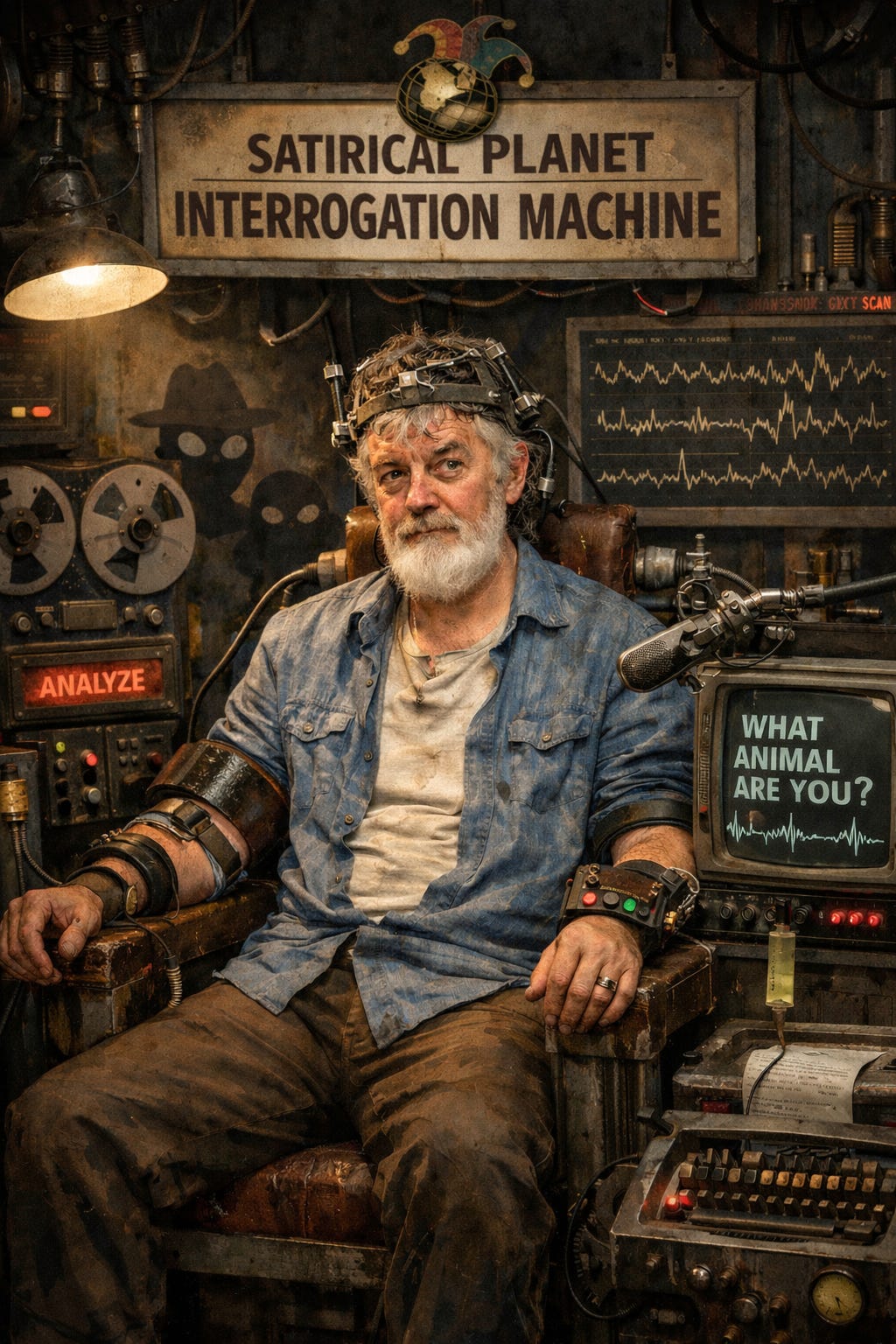
LIMINAL BRITAIN: Chapter One - An Alien in Essex
If you have not read Volume One yet, subscribe to it by this link.
PART ONE of Volume Two A link to all Part One in a PDF, for paid subscribers.
PART TWO of Volume Two