

LIMINAL BRITAIN 2: Chapter Nine
HOLLYWOOD RESISTANCE

If you have not read Volume One yet, subscribe to it by this link.
PART ONE of Volume Two A link to all Part One in a PDF, for paid subscribers.
PART TWO of Volume Two
I had apparently, acquired yet another role that I had never applied for. I was now a dissident. This came as news to me. The trouble with modern America is that one can become a dissident without ever expressing an opinion. All that is required is that someone somewhere concludes you possess one. And I suppose as King I was not expected to have one thus as I did, about what I was not sure, but I was breaking the mould.
The announcement arrived on my phone while I was sitting beside the swimming pool of the Presidential Residence Compound Number Three, formerly known as Beverly Hills. I had finally found my way to that pool full of bikini clad flesh. Though given that none of it seemed to go near the water I had my doubts that it was flesh but rather clever upholstery. This was disappointing as I had hoped it to be an oasis of humanity but I should have realised that the return of my phone meant I was considered in a safe place where flesh and blood could not create a scandalous moment for me and my phone was now totally hacked and incapable of doing anything but keep me in line.
On its screen were the words:
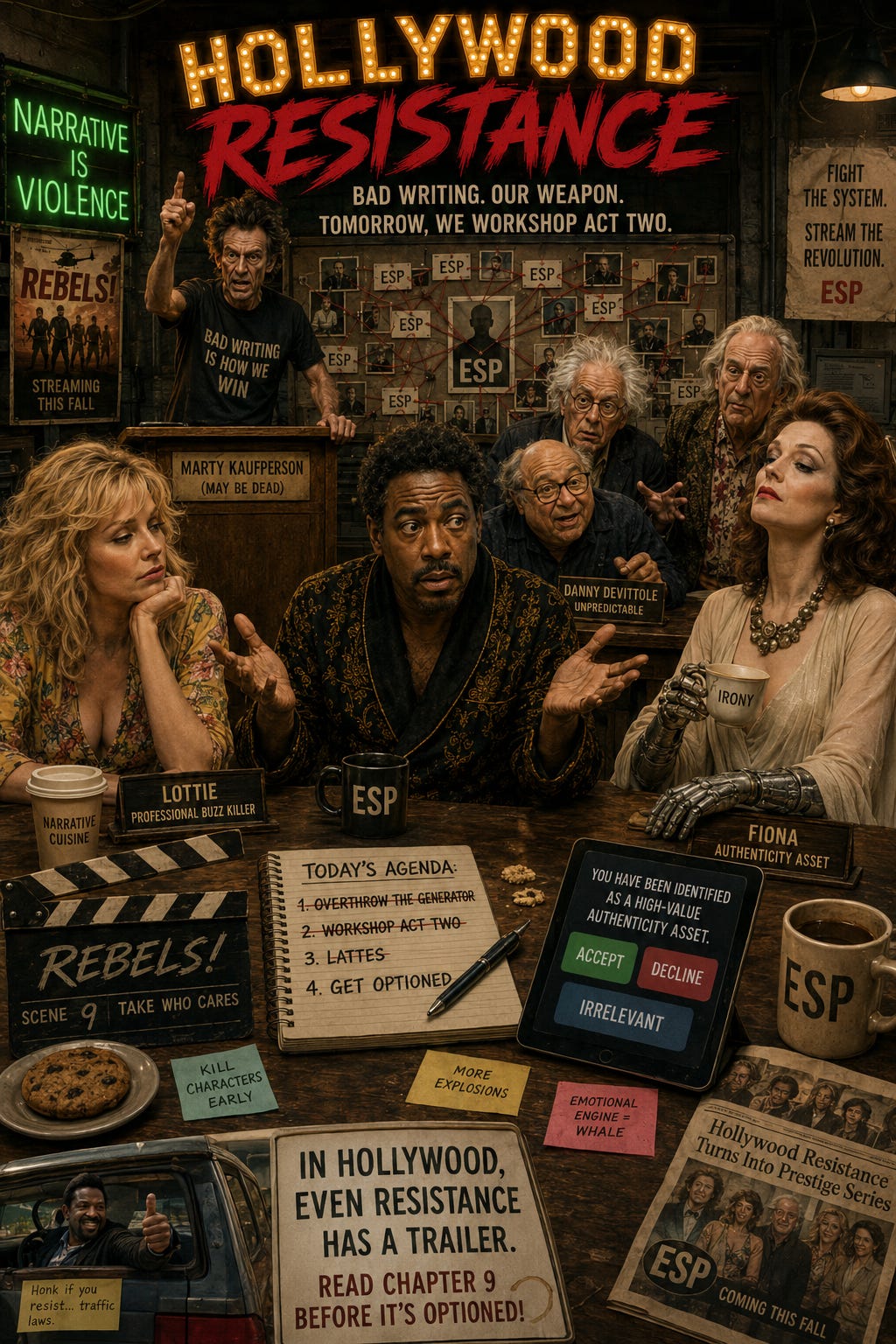
YOU HAVE BEEN IDENTIFIED AS A HIGH-VALUE AUTHENTICITY ASSET.
Below this appeared a button marked ACCEPT.
Beside it appeared another marked DECLINE.
Below both appeared a third marked:
IRRELEVANT.
I pressed Irrelevant.
The phone thought about this. Then it displayed:
SELECTION RECORDED:
AUTHENTICITY ASSET REFUSES CATEGORISATION.
I turned off the screen thinking how clear this had been and how in the many films I appeared, clear and precisely worded texts on large phone screens were the order of the day because the camera could pick that up and there would be a nice insert edit followed by a reaction shot.
Five seconds later Fiona spoke.
“You have joined a resistance movement.”
“I have done no such thing.”
“You pressed Irrelevant.”
“That is not joining a resistance movement.”
“It is in California.”
This was difficult to argue with and I threatened to throw her in the pool. She giggled. Which made me all the more intrigued as to what might happen if I actually did. I assumed her batteries would explode and was overwhelmed with emotion. I was grieving. She was dead. But she wasn’t. But she would most certainly be, though I am certain there was a replacement replica with all the same memories, waiting in the factory. She probably had a warranty. I wondered when it would run out.
Outside the compound walls Los Angeles shimmered in the afternoon haze like a city that had accidentally become famous and never quite recovered from the experience. Palm trees leaned theatrically. Helicopters drifted overhead. Somewhere in the distance a police siren wailed with the bored professionalism of a man announcing another season renewal.
Lottie appeared carrying three coffees and the expression of someone delivering subpoenas.
“We are going out.”
“Get your bikini on. I want someone to frolic in the pool with.”
Now Lottie was not the frolicsome kind. I wish she was but all the time that I had known her, she had been an object of extreme desire but so often a complete buzz killer.
“The Resistance wants to meet you,” she said, pushing a plastic cup of coffee towards me.
“I don’t want to meet the Resistance,” I said as I sniffed the coffee wondering if as soon as I drank it, I would be meeting the resistance or be the resistance. Drugging me was not beyond any of them.
“Nobody wants to meet the resistance,” she said, as if that explained why she was trying to drug me.
“Then why does it exist?”
“Hollywood.”
I considered this. It seemed explanation enough. But I decided not to drink the coffee. She looked annoyed.
“No sugar,” I said.
“Sugar’s bad for you.”
“Caffeine is too. And while we are in conversation, explain why you, who I assumed to now be a bastion of the establishment are talking about meeting the “resistance”?”
She screwed up her eyes and I recalled how I had conjured her up in a Virtual Reality setting in Volume One, and had a considerably intense orgasmic experience in what I now realise was old tech. Consequently, the tech I was experiencing now should be really good, except it was not delivering anything like the fun the old kit could.
Before the Mario Brothers suddenly burst out of the pool and hit me with a spanner, I decided that I had better get my pants on and go with her no matter what her motivations were. And as I recall from Volume One of my memoirs, she had a habit of swapping sides though I was not sure there were any sides, just survival modes. So, I assumed this was another case of swaying with the wind.
If you want to draw any life lessons from this particular piece of literature, and who does not, I would recommend that old Chinese philosophy of blowing with the wind, or as Bruce Lee said, “Be like water.” I think he was quoting Lao Tzu. And the moment that name has come into my mind, I know that sooner or later the algorithm is going to dip into San Francisco and pull up at least an incarnation of Lao Tzu himself.
***
The Resistance, so I discovered, operated beneath a former Scientology building. And as far as I could tell, everybody knew, which made me deeply suspicious because frankly it you are “Resisting” then secrecy I would assume was rather useful. But this is Hollywood and I had come to the conclusion that it revelled in its stereotype and just as one could yell “It’s Chinatown Jake!” to cover up plot holes, just stating that “this is Hollywood” excused all manner of idiocy that could not in reality happen.
Reality was there though. The Los Angeles I actually saw was a bit on the dumpish side with a street plan that had never quite got beyond the first come first served and screw the Mexicans not to mention some obscure Indian tribes who did not gallop about on horses with feathers in their hair. Instead they led a bit of a hunter gatherer life not that far of neolithic Britain’s life style. They lacked the penchant for sticking up big stones in circles but I am sure there were all manner of cultural remnants of their civilisation that did not escape the destructive urges of Spaniards and what passed for Americans.
I suppose there was some effort to disguise where the Resistance congregated because Los Angeles contains many former Scientology buildings and the difficulty lies in determining which ones have actually ceased being Scientology buildings and which merely wish you to think so!
None the less I could have guessed which one without any hesitation. It naturally was rather near to the Writers’ Guild Offices and the Farmers Market which I understand had an amazing range of Oat Milk.
Now although this LA seen from the POV of a Royal State Visit was somewhat tarted up for me, I still could squint through the filter and recall the LA I knew when trying to get bit parts in TV shows featuring some of my Chinese friends kicking cowboys in old China towns of the gold rush era. I figured there weren’t that many gweilo with experience of chop socky but as it turned out, they rather liked their gweilo’s to be genuinely stupid and racist rather than just pretending to be. Authenticity was beginning to be a plague even then, though one would hesitate to raise John Wayne high up the authenticity flag, but in truth I think he was flapping away at the very tip of the pole! He really was like that.
The killer sign that advertised The Resistance was a nondescript notice in the window of what looked like an old Tattoo Parlour to me, except with a few left-over copies of Ron Hubard’s SciFi oeuvre in the window display. It advertised itself as a wellness collective dedicated to ethical mindfulness. Inside it sold six-dollar cucumbers.
“Definitely a front,” I said.
“Yes,” said Lottie.
“For the Resistance?”
“No. For the cucumbers.”
She lied of course. We descended a staircase hidden behind a refrigerated display of vegan cheese. At the bottom lay a speakeasy. Not the sort populated by gangsters but the sort populated by screenwriters. This was considerably more dangerous.
The room contained perhaps fifty people. Every one of them appeared sleep deprived. Every one carried a laptop. Everyone looked as though they had recently lost an argument with an executive. Conversations drifted through the air – well perhaps not conversations, but pitches. Screenwriters rarely speak like normal people. They are constantly trying to sell a story to someone, often as not themselves.
A woman in oversized spectacles leaned towards a man with a beard capable of housing endangered species.
“Imagine Watergate,” she said.
“Okay,” said the beard.
“But underwater.”
He nodded.
“What’s the emotional engine?”
“A whale.”
“Limited series?”
“Prestige.”
“Eight episodes?”
“Obviously.”
Nearby another writer was saying:
“Think Hamlet.”
“Okay.”
“Now remove the prince.”
“What remains?”
“Intellectual property.”
Everyone nodded.
A bell rang and the room fell silent as a thin man climbed onto a small stage containing a lectern. His hair resembled a nervous system attempting escape. I expected Hellfire and Burt Lancaster.
“Welcome,” he announced, “to the Resistance.”
Applause followed.
“Tonight we fight tyranny.”
More applause.
“Tomorrow, we workshop Act Two.”
Thunderous applause.
The man pointed dramatically at me.
“This is Reggie Stokes.”
The crowd stood. Some cheered. Some cried. One immediately attempted to option my life rights.
“I haven’t agreed to any of this,” I said.
“Excellent,” said the man. “Authenticity is what we crave.”
Why that should be a sign of authenticity I do not know but I decided that I should avoid it in the future as it only encouraged people.
The leader introduced himself as Marty Kaufperson. At least that was what he claimed. He looked remarkably like a certain eccentric comedian long rumoured to have faked his own death.
“Didn’t you die?”
“I tested the concept.”
“Successfully?”
“We’re still collecting audience data.”
He ushered me towards a table where several elderly men sat beneath a poster reading NARRATIVE IS VIOLENCE.
One of them had wild white hair. Another looked suspiciously like a taxi-driving eccentric scientist. A third was short, bald and radiated the energy of a caffeinated goblin.
“Marty,” I said.
“Who are these people?”
He lowered his voice.
“The survivors.”
“Of what?”
“Development.”
The short one stood and extended a hand.
“Danny Devittole.”
“Of course.”
“The machine can’t predict me.”
“Why not?”
“I don’t know what I’m doing.”
“That seems common enough.”
“No,” he said proudly. “I mean literally.”
The white-haired man nodded.
“My name is Chris Lloyd-Webber.”
“You’re a composer?”
“Not anymore.”
“What are you now?”
“Anomaly consultant.”
“What does that mean?”
“No one knows.”
Everyone appeared impressed. This worried me.
Marty sat down.
“The Generator is rewriting reality.”
“Yes.”
“It learns from stories.”
“Yes.”
“So, we sabotage the stories.”
“How?”
He smiled.
“Bad writing.”
Silence fell.
Even Fiona looked concerned.
“Bad writing?”
“The ultimate weapon.”
“What happened?”
“We tried it.”
“And?”
Marty pointed towards a television. A trailer was playing announcing an eight part prestige series entitled: REBELS! BASED ON TRUE EVENTS.
It starred attractive versions of everyone in the room and was “Executive Produced by Everyone.”
The crowd groaned.
“Every time we resist,” Marty said, “the Generator turns resistance into content.”
The trailer ended. A slogan appeared.
COMING THIS FALL.
FIGHT THE SYSTEM.
STREAM THE REVOLUTION.
Nobody spoke for a long moment.
Then Fiona quietly said:
“It is learning faster.”
I looked around the room. For the first time the joke stopped being entirely funny. And for the first time I noticed something else: a symbol that flashed intermittently. It was tiny, barely noticeable, but it repeated on laptops, invoices, funding documents, and coffee cups. It contained three letters: ESP. It came, it went, and I had no idea and still have no idea how it did that, other than via some electrical interference in my brain.
At first, I assumed it referred to psychic powers. In Los Angeles this was a reasonable assumption. Then I noticed everyone becoming nervous whenever it appeared, thus it was also appearing in their brains as well. And suddenly I had the uncomfortable feeling that I had seen those letters before. Somewhere much closer to the centre of the story. Much closer to the man nobody seemed able to name.
Marty Kaufperson insisted upon buying me dinner, naturally. This was much better than being offered a Breakfast Meeting at seven a.m., a notorious ploy to make you feel inadequate for wanting to sleep instead of further your supposed writing career. Unfortunately, it meant spending three hours listening to Hollywood writers explain why they had become revolutionaries.
Historically speaking, revolutions have often been launched by hungry peasants, oppressed workers, disaffected soldiers, intellectuals, aristocrats, religious fanatics and occasionally football supporters. As far as I am aware this was the first one to be launched by people with representation agreements.
The restaurant occupied the rear of the speakeasy and specialised in what it described as Narrative Cuisine. The menu did not list food. It listed character arcs. One could order Redemption with Truffle Oil. One could order Generational Trauma with Seasonal Vegetables. One could order The Hero’s Journey. And the Hero’s Journey arrived in twelve courses and cost three hundred dollars.
I settled for Fish.
The waiter looked disappointed.
Around us conversations swirled. The Resistance, despite its name, appeared less interested in overthrowing the Generator than pitching alternatives to it. One table was discussing a proposal entitled Democracy 2.0. Another was debating whether reality itself needed a stronger third act. A third had become trapped in an argument about whether irony was a colonial construct.
I was beginning to suspect that if civilisation ever collapsed entirely, Hollywood would continue producing panel discussions long after oxygen had become optional.
Marty slid a folder across the table.
“Funding.”
I gingerly opened it fearing it would explode. The first page contained a list of foundations. The second page contained another list of foundations. The third page contained a list of foundations funding the first two lists of foundations. It resembled an aristocratic family tree drawn by an accountant suffering a nervous breakdown.
“Look at the initials.”
I did.
ESP.
The letters appeared repeatedly. Sometimes as grants. Sometimes as shell corporations. Sometimes as consulting firms. Sometimes as production companies. Sometimes as charities devoted to empowering underserved narratives. And I wondered what sort of fairy tale I had slipped into. I was definitely not in Kansas anymore and even less in Watford, and even less in my beloved Hong Kong where I knew reality had long departed and replaced itself with dim sum and deep-fried squid on the waterfront of Sai Kung. I could feel myself getting all nostalgic for the life I once had.
“Nobody can find the owner,” said Marty, bringing me back into what I suppose was the present, though time has ceased to be measurable for me.
“Ok,” I said, taking the bait, “Why can nobody find the owner?”
“We did.”
“Ah, so it was not true that nobody could find the owner, unless you consider yourselves as nobodies? I can understand how screenwriters come to that conclusion.”
“We found another company.”
“And er… where’s this going?”
“And it was owned by another company.”
“And who owns that?”
“Another company.”
I nodded. Of course. America had perfected capitalism to such a degree that money itself now possessed plausible deniability. At that moment Fiona, who had been sitting silently beside me, suddenly turned her head. Her eyes unfocused and for several seconds she appeared to be listening to something far away.
“What is it?” I asked.
“Someone is searching for you.”
I felt a faint chill.
“Who?”
She blinked.
“The Duke and Duchess of Montecito.”
“Good Lord.”
“Technically not.”
“No?”
“Contractually ambiguous.”
Being of a creative bent myself I imagined that several hundred miles away, Prince Harry Windsor-Mountbatten-Spencer-Sussex-Netflix, or whatever his lawyers currently allowed him to call himself, was standing inside a roadside crystal emporium outside Palm Springs.
Now, if you recall from Volume One, I replaced the legitimate monarch of the UK. So, it stands to reason that his children would be somewhat concerned about his disappearance. Indeed, I also was concerned, though I was even more concerned about my own disappearance, hence my desire to go hide in the bogs of Ireland. It was thus hardly surprising that a sub plot must have been brewing all this time and that Harry, having moved to America, must have become convinced that the missing King of Britain was also hiding in America.
This was not entirely unreasonable. Several previous monarchs had hidden in stranger places.
“OK,” I said to Fiona, fill me in on the details.
I could see that her mind was accessing a data base and pulling up gobbets of information that she was assessing and fitting into some sort of narrative for me. She began barking out short little sentences occasionally punctuated with bizarre similes likening everything to “regret”, a word that I was desperate to eliminate from my vocabulary but it was built into her infrastructure for some reason.
Let me try sum up what she said to me. She went on and said Harry had become convinced that every rumour was true. If someone reported that the King was working as a bartender, Harry investigated bartenders. If someone claimed he had become an Uber driver, Harry interrogated Uber drivers. If someone suggested he was living among retired Elvis impersonators, Harry immediately drove to Nevada. This had produced a remarkable amount of travelling and almost no useful information.
Beside him Meghan had stood with the patient expression of a woman who had spent several years discovering that reality rarely matched press releases. A crystal merchant pointed towards a large lump of quartz saying: “The King speaks through this one.” Naturally they had ventured into a magic crystal emporium. I could imagine the visual possibilities of that location as I entertained the notion that Fiona was not so much filling me in on the actual details of real events, but simply making a pitch.
“What does he say?” I said, going along with the moment like a good Vice President of Acquisitions was forced to do during their scheduled hour of pitch meetings with nervous writers.
The crystal merchant listened to the crystal but the crystal remained silent, though apparently not to him. Eventually he nodded gravely.
“He says he prefers not to be found.”
Harry looked devastated and Meghan sighed.
“That’s the eighth King this week.”
“The ninth.”
“The llama doesn’t count.”
“It might.”
“It was a llama, Harry.”
“An unusually regal llama.”
I must say that I thought Fiona’s English accent was very good, though she gave that to Meghan, and Harry, sounded all too much like he had spent too long dealing in drugs deep in the Bronx. But as a comedy turn, I thought Fiona had a future.
Just when I thought things were getting strange, the evening was becoming stranger. Or perhaps I should rephrase that. Just when I thought things were way too strange to be in the least bit believable, things really did get strange and lurched into the totally implausible, audience confusing, uncanny 2001 and Space Odyssey end sequence boggle.
Marty introduced me to a woman called Zelda Frame. At least I think that was her name. She may have changed it twice during the conversation. She specialised in tracing Generator influence networks. In simpler times this would have been called journalism but now nothing could happen without some new jargon. But then perhaps all language is just jargon. Beowulf was just the jargon of the dark ages and the Anglo-saxons of the time were most likely bitching about the decline of old English into new English, or as they would have put it, teenage slang.
Zelda spread photographs across the dinner table and announced the following list: Board members, Executives, Political donors, Media consultants, Think tank directors, Tech founders, Hollywood producers…
And all the time I am thinking how lists are now appearing in my reality. Hollywood cannot possibly have been taken over by list generators, but then I remembered the huge long lists of credits at the ends of movies and it dawned upon me that probably the only people who ever read the credits were people who lived in Hollywood looking for the names of people they hated and knew did not disserve whatever credit they got!
“The same faces,” said Zelda loudly on noticing my attention was drifting, “The same faces appear repeatedly! Thirty of them can be spotted in the crowd, on the edge, reflected in a mirror. Never quite visible. Like sharks glimpsed beneath water. Or lawyers. And ESP touches all of them! And nobody knows who runs it.”
I could tell by all the nodding heads about the table that conspiracies are comforting. They imply control and intention and maybe responsibility. But systems… Systems can become something else. The Generator was beginning to feel less like a machine and more like weather. Nobody owned a hurricane. Yet people still drowned in one. Where my thoughts had gone towards some great AI takeover of reality that we should fight against, I realised that despite any rebellious utterance that I could make, it would never kill this desire for everything to be the fault of some secret cabal of conspirators who controlled everything. Especially if they were Jewish. Where I saw something out of control, around me people were sure someone was doing it all for whatever megalomaniac obsession they had. Some alien god would also be invoked. I heard “Baal” being a favourite. Though why I do not know as I believe it meant “husband”. And yeah, why not. I wish my ex-wives had thought me a god.
The meeting might have continued for several more hours had not an argument broken out at the far end of the room concerning whether reality itself should continue.
At first, I assumed this was a philosophical discussion. After several weeks in California, I had learned that one should never immediately dismiss a sentence simply because it sounded insane. Often the apparently insane statement turned out to be the practical one. Unfortunately, this was not philosophy. This was television development.
A producer in a black polo-neck stood beside a large screen saying, “Reality is underperforming with younger demographics.”
A murmur ran around the room.
“I’ve seen the numbers,” he continued.
Someone raised a hand.
“Can reality be rebooted?”
The producer shook his head.
“We tested that.”
“What happened?”
“The focus groups preferred dragons.”
Nobody appeared surprised and a woman with purple hair sighed.
“That’s always the problem,” she said.
For several seconds I genuinely believed she meant it. Then I realised she did.
Around the room heads nodded. Notes were taken. Action points were assigned. Reality, it seemed, was once again in development hell, and my presence seemingly totally forgotten!
As I was being ignored I became increasingly distracted by the letters ESP. The symbol seemed to have acquired a life of its own. The more I looked for it the more frequently it appeared. On walls. Screens. In reflections. On the corner of presentation slides.
I began to suspect that either a secret organisation was operating at the centre of American society or I was developing a neurological condition. Neither possibility particularly appealed. I eventually pointed towards a coffee cup.
“You see that.”
Those who had felt it impolite to ignore me entirely, looked uncomfortable, wishing they had and were involved in the debate on whether reality was feasible any more.
“What about it?” asked Marty.
“The initials.”
“What initials?”
“ESP.”
Several people seemed to become interested and then immediately looked away when they saw that I had noticed them. One man started studying his shoes. Another became fascinated by a napkin. Danny Devittole muttered something about parking validation.
“You’re all behaving very oddly,” I said.
“We’re writers,” said Marty.
“That’s not a defence.”
“No. It’s an explanation.”
Before the discussion could continue, the door at the far end of the room burst open. A young assistant rushed inside carrying a tablet. He looked terrified – I had worked out by now that Hollywood assistants frequently look terrified because Hollywood functions upon the principle that fear is cheaper than management.
“They’ve done it again,” he declared.
The room froze.
“Done what?” I said.
The assistant held up the tablet. A trailer was playing. At first I assumed it was another advertisement. Then I recognised the room. I recognised the people. I recognised myself. At least a younger and considerably better-looking version of myself. Though, surprisingly, black.
The title appeared in enormous letters: REBELS!
The crowd groaned. A prestige series had rather rapidly advanced from concept to production. This was particularly impressive because the events depicted had just occurred. And then it went onto events that were supposedly the result of these events: explosions, helicopters, gunfights, passionate speeches! An attractive actress portraying Lottie delivered a monologue about truth that frankly had Islamic overtones. I assume it picked up something of that vibe from my involvement in some Pakistani films and films shot in Central Asia.
I searched the screen for a variant of Djamal but for some reason they had missed that connection or given his lines to Lottie.
As for Lottie, the real Lottie, realish, she stared at the screen muttering: “I’ve never said any of those things.”
The actress continued speaking.
“I don’t even believe those things,” protested realish Lottie.
The trailer ignored her.
An actor portraying Marty Kaufperson detonated a building. The real Marty looked mildly offended.
“I wouldn’t use that much CGI.”
The trailer concluded with a familiar logo. Three simple letters: ESP.
For several seconds nobody spoke. Then Fiona quietly said:
“It either instantly used this meeting or it predicted this meeting!”
“No,” said Marty. “It couldn’t.”
Couldn’t do what, I was not sure, but whatever it was, Marty insisted it was impossible. But I was not so sure either way, because I had long sensed that what I was experiencing was scripted and though my ability to improvise even when given a script was legendary, I still ended up following the basic idea of the script. At least that’s what I told the frustrated director. It will be ok in the edit, I would tell the director who knew he was going to dub me anyway.
We watched the trailer again. This time details emerged: A line of dialogue, a sequence of events, a confrontation… Each one corresponded not to things that had happened, but to things people around the room were currently suggesting. The Generator was getting ahead of them even as we spoke: like a novelist reading over his own shoulder and making corrections even as he was still writing the damned thing! (You are probably having difficulty in working out how that works but if I was so inclined and I am, may I suggest it is something to do with quantum physics and entanglement and a cat in a box.)
The room suddenly felt smaller – did I mention a cat in a box? - and I found myself remembering something Brother Chan had once told me while standing beside a stone older than civilisation: stories are dangerous, not because they are false, but because they become true! At the time I had assumed he was speaking metaphorically. Increasingly I suspected he was not as he would go on about one’s thoughts manifesting themselves through some mysterious workings of the universal consciousness.
The meeting dissolved shortly afterwards. People drifted away in anxious clusters. Writers who only an hour earlier had been plotting revolution now seemed worried that revolution might already have a showrunner. And worse, they, whoever they were, knew where they lived.
Outside, Los Angeles shimmered beneath a haze of sodium lights and optimism. Traffic crawled. Billboards glowed. A helicopter crossed the sky. For a moment I found myself wondering whether the helicopter was real. Then I realised that was exactly the wrong question. The more important question was whether reality itself still cared.
Lottie drove the car I was now in and Fiona sat beside me in the back. Nobody spoke for several minutes. The city rolled past and I experienced a montage of movie posters, campaign posters, streaming advertisements, and political slogans. Increasingly they appeared interchangeable.
Eventually I said: “Who owns ESP?”
Fiona looked out of the window.
“I do not know.”
“Nobody knows?”
“Someone knows.”
“Who?”
She considered the question. I could almost hear processes moving behind her eyes. Thousands of possibilities were being weighed, rejected, and reassembled until finally she answered.
“That is the wrong question.”
I looked at her.
“What is the right question?”
For the first time that evening she seemed genuinely troubled, not confused, but troubled, as though she had reached the edge of something, as though her own programming disliked what it had found there.
“The question is why.”
“Why what?”
“Why it exists.”
“And?”
She was silent for a long time as she worked out the intricacies of a left hand turn across a main road in a country with a hatred of roundabouts, and I was beginning to feel that I had slipped into some Swedish art house movie where long silences and poignant looks against misty backgrounds won prestigious awards and baffled guys like me who wanted something to explode and someone to kick someone in the head.
Outside a billboard displayed the smiling face of the Butler, President of the United States, Defender of Democracy, brought to you by six sponsors and selected streaming partners. The billboard vanished behind us and Fiona continued staring into the darkness.
Then she finally spoke.
“He does not believe in ideology.”
The words sounded oddly precise. Like a quotation. Like something she had discovered rather than concluded. And I waited, nervously, but fascinated because I knew that Fiona was in many ways my spy on the workings of the Generator. A moment later she added: “He believes in optimisation.” And suddenly, although I still had no idea who “he” was, I felt colder than I had all evening, which, considering this was California, took some doing.
Lottie remained enigmatically in Bergman mode and I suspected she was replaying Cries and Whispers in her mind, for despite my insistence that everything is a joke, a huge comedy, she was sinking into the idea of death and how our response to it was positioned on the borders between reality and nightmare, tranquility and terror.
Then there was a loud Honk from a car cruising beside us driven by the Somali ex-gunship driver giving us a big thumbs up before having to grab his steering wheel to avoid crashing into a school bus and no doubt surviving to be arrested for terrorism.
PART ONE of Liminal Britain Volume Two

This Substack is reader-supported. To receive new posts and support my work, consider becoming a free or paid subscriber. Paid subscribers have access to other novels and short stories, plus the ability to download PDF’s containing collections of writings. Here you can find the first eight chapters of Volume Two for your convenience… if you are a paid subscriber.
If you have not read Volume One yet, subscribe to it by this link.
PART ONE of Volume Two A link to all Part One in a PDF, for paid subscribers.
PART TWO of Volume Two
I found myself nodding along while reading this. The specific details made it feel real, but the message felt universal. That's a difficult balance to strike, and I think you pulled it off well.