

Liminal Britain 2: Chapter Seven
The Offer

If you have not read Volume One yet, subscribe to it by this link.
PART ONE of Volume Two A link to all Part One in a PDF, for paid subscribers.
PART TWO of Volume Two
I had just discovered that the greasy little theatrical disaster known as Prometheus in Plaistow had, apparently, been funded by the same unageing smiling function currently floating through American power like a turd that had learned etiquette, when Lottie decided that what I needed was a wellness excursion. This is one of the many terrible things about California. In most places, when a man discovers that his entire adult life may have been manipulated by a conspiracy linking fringe theatre, artificial intelligence, child resilience foundations, Presidential butlers and a dead lover rebuilt as a rechargeable emotional appliance, someone offers him whisky. In California they offer him hydration.
“We’re going to Santa Barbara,” she said.
“Why?”
“Because you need perspective.”
“I need a lawyer, a pen, and possibly an exorcist.”
“Perspective first.”
And so, after the discovery of the Prometheus file, after the screen went black, after Fiona said we had been in rehearsal for a very long time and then promptly went into low-power mode like Cassandra fitted with a lithium battery, I found myself driven north through California in a vehicle whose seats had the softness of a lost plot. I blame it on my memory. I had so many good intentions about telling you my story and making it really zing, pushing the plot forward, dangling the suspense, pushing up the jeopardy, and of course the sexual tension between me and Lottie, well… excuse me I am just considering that. I am writing this from the future and I know what she becomes. Let’s just say she puts on weight and somehow isn’t how I remember her when I first met her. But nevertheless, I am telling you the story as it comes supposedly without the knowledge of what happened and thus giving you how I saw things at the time. I am sure Thomas Pynchon with his V character never really had an issue with the perspective of the narrator. But I do. So, perspective then…
The Pacific appeared now and then beyond the traffic, blue, indifferent, and probably overvalued. Lottie sat opposite me doing something to her phone that involved several governments and no visible conscience. Fiona sat beside me with her eyes closed, charging through a port in the upholstery. I wondered if that made her a passenger, a device, or a very expensive glove compartment.
California is beautiful in a way that makes you distrust beauty. It has too much light. The hills look as if they have been pre-approved by an awards committee. Even the dryness has confidence. In England, landscape apologises for itself. In California it has management. The palm trees stand there like extras who have been told they are essential to the mood but not to ask questions about the plot.
We stopped briefly at a viewpoint where an aide offered me a green drink.
“What is it?” I asked.
“Longevity blend.”
“I’m seventy-three and short of returning to live in Hong Kong, stand an alarming twenty five percent chance of a heart attack within the next five years, and pretty much a hundred percent chance of prostate cancer, which may or may not finish me off within ten years. In HK I’d stand a chance of hitting ninety because, I suspect, of the attentions of nubile Chinese girls and decent food. Here, what’s on offer?”
“It’s based upon a Chinese drink. And it supports cellular optimism.”
“I don’t want optimistic cells. I want obedient ones. And I bet it bares absolutely no relation to anything out of a Bubble Tea House in Sham Shui Po.”
The aide made a note, struggling over Sham Shui Po. I have noticed that whenever I say something sensible in America, somebody makes a note and later uses a highly inaccurate version as evidence against me.
By the time we reached Santa Barbara, I had developed the peculiar exhaustion that comes from being both jet-lagged and narratively over-handled. We pulled up outside a gym. Not a tasteful old gym with boxing gloves and towels and the comforting smell of ancient leather, but a Californian temple of self-correction, all glass, steel, eucalyptus, and people trying not to die while pretending to enjoy themselves. There were fountains. There were orchids. There were men in sleeveless tops who had clearly misunderstood the difference between health and architecture.
“Absolutely not,” I said.
“You don’t have to exercise,” said Lottie.
“I should hope not.”
“We’re here to show you something.”
That worried me. “Showing” had become a word I associated with revelations, betrayals, and PowerPoint.
Inside, the air smelled of disinfected ambition. People ran on machines while going nowhere, which struck me as a near-perfect image of civilisation. A row of treadmills faced enormous screens showing mountain trails, forests, beaches, and other places one might visit if one were not voluntarily trapped in a room performing labour for no practical outcome. I have never trusted treadmills. They are the only machines specifically designed to turn effort into proof of futility.
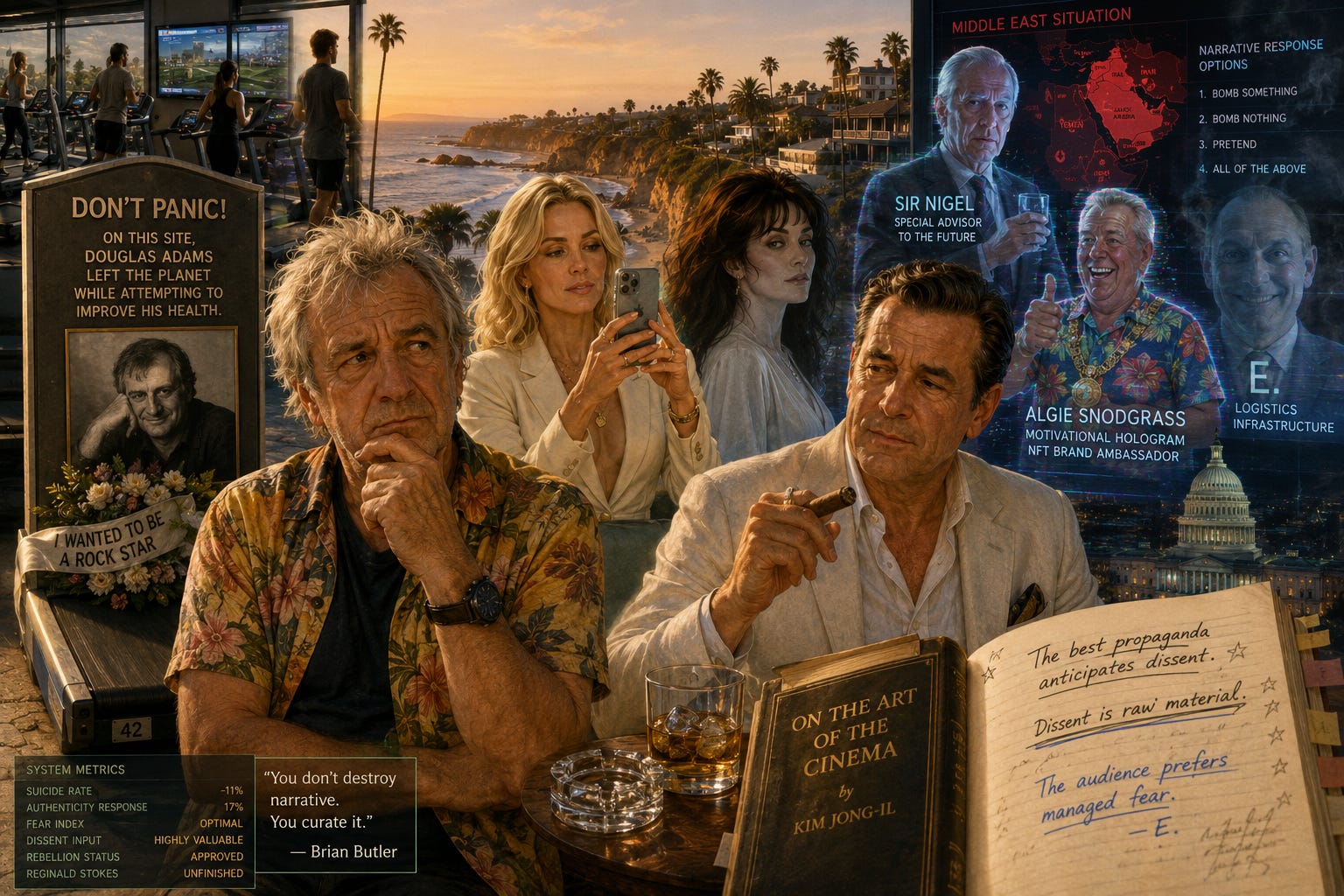
At the end of the row stood an old treadmill under a glass cover with a large and impressive plaque bearing the words: Don’t Panic!
I moved closer and read the small print: ON THIS SITE, DOUGLAS ADAMS LEFT THE PLANET WHILE ATTEMPTING TO IMPROVE HIS HEALTH.
I stood there for a moment.
I had met Douglas Adams once, years ago, at a prize-giving. I was receiving an award for a science-fiction television series about a university devoted to discovering the Bench Constant, which, as I have mentioned elsewhere, was the mysterious number one could add to any equation in order to get the result required by the commissioning editor. The series was never made, naturally, because television has an instinctive horror of ideas that arrive already funny. Douglas was tall, charming, slightly distracted, and gave the impression that he had wandered into reality while looking for another room. He made one remark about deadlines which I have forgotten, though I remember laughing because everyone did, and because laughter is contagious among writers, especially when one of them is successful.
There was a wreath in the photograph beside the plaque. The ribbon read, if memory serves or has been improved by grief, I WANTED TO BE A ROCK STAR. That line always moved me because it was ridiculous and true. Most writers want to be rock stars. Most rock stars want to be poets. Most poets want to be dead enough to be taken seriously. The whole of culture, when examined closely, is a queue of people wishing they were in another queue.
“So this is why you brought me here?” I asked.
Lottie was watching me carefully. “The fan base likes him.”
“The fan base?”
“Yours. Ours. The overlap is useful.”
“I am standing beside a death treadmill because it tests well with literate men who distrust exercise?”
“That’s one way of putting it.”
“It may be the only way of putting it.”
Lottie quickly took a Twofy and sent it to Instagram before I could spoil the moment, and Fiona opened her eyes, saying: “Douglas Adams represents comic metaphysical resistance to bureaucratic absurdity.”
“Thank you,” I said. “That sounds exactly like the kind of phrase that would have made him take a long lunch.”
She tilted her head. “He would have disliked being reduced to a demographic cluster.”
“Most dead writers do. It’s one of the few advantages of death.”
A gym instructor appeared, smiling with the evangelical pity of a man who believes stretching can heal capitalism.
“Would His Highness like to try the commemorative machine?” he asked.
“No,” I said. “His Highness would like to survive the chapter.”
The instructor looked disappointed. “We have a gentle mode.”
“I am already in gentle mode. It took decades to achieve.”
Lottie touched my elbow and steered me away before I could make a speech about mortality and membership fees. As we left, I looked back at the treadmill. It occurred to me that Douglas Adams had given the world the answer forty-two, and the world had responded by building machines on which people ran in place while looking at simulated scenery. There was probably a joke there. Unfortunately, it was too sad to be funny, which is where all the best jokes eventually retire.
Outside, the light was beginning to soften, and the Pacific did its enormous blue thing in the distance. A helicopter waited on a lawn that I suspected had never known a poor person. I did not like the helicopter. Helicopters have always struck me as machines that remain in the air through bribery.
“Where now?” I asked.
“The President wants to speak with you privately.”
“Could he not have done that in Los Angeles?”
“He wanted you softened.”
“I am not softened. I am lightly traumatised and full of green liquid.”
“That will do.”
The helicopter took us along the coast. Below, the ocean glittered. Houses clung to cliffs. Wealth spread itself across the hills in white villas and blue pools. I thought again of the smiling man, of E, of Prometheus in Plaistow, of Fiona playing Late Capitalism above a carpet warehouse without knowing that Late Capitalism may already have bought a ticket. There are moments when paranoia ceases to be a mental state and becomes a reasonable reading of the available evidence.
We landed at a private estate north of Malibu, though “estate” is too modest a word. It was a coastal compound built in the style I have come to think of as democratic imperial: glass, stone, guards, infinity pool, and the faint implication that laws are for people who arrive by road. The Butler was waiting on a terrace, smoking a cigar in defiance of health, etiquette, and possibly coastal air regulations. He wore a linen jacket over a shirt open at the neck, making him look less like the President of the United States than a nightclub owner who had unexpectedly inherited NATO.
“Reggie,” he called. “Come and look at the sea. Makes everything seem less fucking stupid.”
“It isn’t working,” I said.
He laughed. But not much.
Lottie stayed back. Fiona remained beside the helicopter, staring at the waves as if trying to download them. I followed the Butler to the edge of the terrace. For a while we said nothing. I did not mind that. Silence is different beside the sea. It belongs to something older than briefing notes.
“You’ve seen enough now,” he said eventually.
“I’ve seen a death treadmill, a Reagan impersonator, an existential chimpanzee, a fortune-telling machine that defamed me, and evidence that my fringe theatre career was funded by a man who doesn’t age properly.”
“Good. Then you’re up to speed.”
“Brian,” I said.
He winced.
“Don’t.”
“So it is true.”
“Unfortunately.”
“Brian Butler.”
“My fucking parents lacked imagination.”
“Were they really called Butler?”
“Yes.”
“And you became a butler?”
“It was either destiny or poor careers advice.”
I looked at him. “You have to admit it sounds invented.”
“That’s why it worked. Nobody suspects the obvious. Everyone looks for hidden bloodlines, secret societies, lizard ancestry, Venetian bankers, ancient cults, Jesuits, Freemasons, the usual buffet. Nobody looks at Brian from Essex.”
“That may be the most convincing thing you’ve said.”
He nodded toward the ocean. “The world is mostly run by people with ridiculous names. You just stop noticing once they have offices.”
This was true enough to irritate me. I thought back to Volume One and how The Butler there was somehow, much more Essex and much odder. Here he had had a California make over and was blander and less Blanding Castle. And the mystery of how he got elected while I was stuck in the Irish Bog was still a mystery, except I wondered if E had something to do with it. Somehow I figured that a Butler would know all the secrets and be either exterminated or, raised to high office.
He handed me a drink. I sniffed it.
“Poison?”
“Single malt.”
“That doesn’t answer the question.”
He smiled, tiredly this time. Properly tired. Without performance. For the first time since arriving in America, he looked less like a usurper and more like a man who had been standing too long at a fire trying to decide whether to put it out or warm his hands.
“You think I’m the villain,” he said.
“I’m keeping the position open.”
“I didn’t build this.”
“No. You merely became President of it.”
“I manage it.”
“That’s what all villains say between the second act and the speech where they explain the volcano.”
He looked at me sharply. “You don’t destroy narrative, Reggie. You curate it.”
There it was. The line. Neat, polished, dangerous.
“You sound like Lottie.”
“She sounds like me. Or I sound like her. At this point authorship is a shared infection.”
“That is not reassuring.”
“It isn’t meant to be.”
He took a long drag on the cigar and coughed violently toward the Pacific, as if trying to poison something larger than himself.
“You’re not supposed to inhale,” I informed him. Extraneous advice is one of my vices.
He gave me a look. “Listen,” he said. “Human beings cannot live on truth. They say they want it, but what they mean is they want the version that leaves them able to get up in the morning. You expose too much reality too quickly and people collapse. They don’t become free. They become frightened, then angry, then useful to somebody worse.”
“Worse than you?”
He looked genuinely hurt. “I reduced suicide by eleven percent.”
That stopped me. I did not want it to. I wanted a villain. I wanted a moustache, a lair, a man stroking a cat and explaining that he had always hated Luxembourg. I did not want an exhausted former butler with an miraculously enhanced vocabulary standing by the Pacific telling me that his grotesque machinery had saved people who might otherwise have died. Moral complexity is deeply inconsiderate when one is trying to be heroic.
“Eleven percent,” I said.
“Across aligned populations.”
“Aligned populations?”
“Places where the Generator’s emotional stabilisation protocols run cleanly.”
“You mean places where people are managed and there are no error messages saying unstable network connection”
“Yes.”
“At the cost of what?”
“Some spontaneity. Some chaos. Some truth. Some art. Some despair.”
“You say that as if despair is a minor inconvenience.”
“It isn’t. That’s why we regulate it.”
I stared at him and wondered what would actually happen in a world where nobody regulated anything! And was there ever a sweet spot.
“You regulate despair.”
“We regulate exposure to despair. Very different.”
“It isn’t.”
“It is if you’re alive because of it.”
That landed harder than I wanted. I thought of Fiona. I thought of the young actors in the raw footage stopping for six seconds and not knowing whether they were allowed to exist without direction. I thought of Brother Chan in the stone circle telling me truth does not travel well. And I hated the Butler for being plausibly right.
He knew it too.
“That’s the trouble,” he said. “You understand.”
“I understand enough to be alarmed.”
“That’s why I need you.”
“No.”
“You haven’t heard the offer.”
“I’ve heard enough offers. They usually begin with flattery and end with my trousers being misplaced.”
“You are the corrective.”
“You said that before.”
“And you hated it because it sounded true.”
“I hated it because it sounded like a job title invented by a committee that had killed three poets.”
He smiled faintly.
“We need opposition inside the frame. Real opposition. Not the studio-approved kind. Not those rebels in black polo necks who take foundation money and call it subversion. You.”
“Why?”
“Because you still create narrative gaps.”
“I thought gaps create anxiety.”
“They do.”
“And you want me to create anxiety?”
“Managed anxiety.”
“Oh good. For a moment I thought civilisation was in trouble.”
He ignored that.
“The system is too smooth. It anticipates too much. People are becoming predictable before they have time to be alive. We need friction. We need the incomprehensibility of a Kung Fu Movie Plot with a white villain played by an actor who clearly has no clue as to what is going on!”
I resented the implication that I was the sort of crap actor that could only get walk on parts in foreign films requiring them to be nothing more than evil Englishman number Two.
“You want me to be grit in the machine.”
“I want you to remind the machine it is a machine.”
“That is almost noble.”
“Don’t worry. There’s a travel allowance.”
The Butler walked to a small table and picked up Kim Jong-il’s On the Art of the Cinema. Of course it was there. The cursed book had begun appearing everywhere, like an ideological Gideon Bible. He handed it to me again.
“Read it properly this time.”
“I have read it.”
“No. You’ve reacted to it. That’s different.”
I opened it reluctantly. The marginalia seemed denser than before. New underlinings. New arrows. New little exclamation marks of lunacy. Some of the handwriting I recognised as mine. Some I did not. One note beside a passage on the director’s duty to guide the audience had been written in blue ink so fresh it gleamed.
The best propaganda anticipates dissent.
Below it, in a thinner hand: Dissent is raw material.
I looked up.
“Did you write this?”
“No.”
“Lottie?”
“Possibly.”
“Me?”
“Also possible.”
“You understand how unhelpful that is?”
He nodded. “Yes.”
I turned another page. A new line appeared in the margin. I was sure it had not been there before.
The audience prefers managed fear.
It was signed:
— E.
I shut the book.
“Who is E?”
The Butler looked out at the sea.
“He handles logistics.”
“Who?”
“You’ve met him.”
“The smiling man.”
He said nothing.
“The one who doesn’t age in photographs.”
“He ages.”
“So everyone keeps telling me.”
“In ways you don’t see.”
“That phrase is becoming extremely annoying.”
The Butler’s face hardened. Not much. But enough.
“He is not the enemy.”
“People keep saying that about people who behave exactly like enemies.”
“He is infrastructure.”
“That is worse.”
“He moves money, people, favours, silence. He opens doors. Closes others. Makes sure difficult things happen far away from those who benefit.”
“So a criminal.”
“A function.”
“Stop calling people functions. It makes me want to become religious.”
He laughed then, but without amusement.
“You think politics is about belief. It isn’t. Belief is for speeches. Politics is logistics. Who gets there. Who pays. Who is compromised. Who disappears from the record. Who gets the scholarship. Who gets the island. Who signs the waiver. Who owns the footage.”
I felt cold, despite the Californian evening.
“Footage.”
He gave me a look.
“You were an actor, Reggie. You know the power of footage.”
“Only when badly lit.”
“You know exactly what I mean.”
I did not actually. This conversation had gone into a zone that often happened in the movies I was in. I remembered my lines in Chinese, phonetically, and said them with whatever feeling I could muster while having no idea what the story was, and then the next scene would have me being thrown out of a helicopter and holding a bizarre conversation with someone dropping beside me who had a parachute that they would give me if I gave the right answer to a question… Actually when I think about it, that was a great scene! That movie did really well and I still have no idea what my part in it was all about.
Suddenly, a screen built into the terrace wall came alive. Sir Nigel appeared, seated somewhere darkly panelled, brandy in hand, looking like the British Empire had survived as a private members’ club with nuclear access. A map glowed behind him. The Middle East was pulsing red in several places, which I took to be bad.
“Ah,” said Nigel. “There you are. Enjoying the state visit, cementing the special relationship, which is even more special now that we’ve managed to get ourselves a Brit in the Oval Office! Whoever said that Britain was finished!”
“Nigel,” I said. “How nice. I was beginning to worry the evening lacked hereditary menace.”
“Reggie, do try to focus. We have a developing situation.”
“Where?”
“Several places.”
“That sounds careless.”
“The Gulf is unstable. The usual people are demanding the usual response. The American people want decisive action, the Europeans want moral clarity without invoices, and our own chaps want to know whether this can be turned into a procurement opportunity. So what d’you say “BRIAN!”
The Butler sighed as Nigel laughed. “Nigel.”
“Yes, BRIAN?”
I enjoyed that. The Butler did not.
Nigel continued. “The problem, as ever, is narrative. If one bombs the wrong thing, one looks reckless. If one bombs nothing, one looks weak. If one bombs the right thing, one discovers later it was a hospital, a wedding, or a drone factory funded by one’s allies.”
“Then don’t bomb anything,” I said.
Nigel gave me the sad look powerful men reserve for civilians who have noticed the obvious.
“Dear boy, you cannot simply not bomb things. The absence of bombing creates a vacuum, and nature, as the Greeks probably said, abhors an unbombed vacuum. So BRIAN, what sort of hell is on the menu?”
I paused for a moment as I heard a drone homing in on us. Surely this was not some pre-emptive strike coming in? And I was sure security here would blast it out of the sky… but then it stopped and a flickering light beamed down like an effect from an old sci-fi movie and Algie appeared as a hologram, though the technology had not been kind. He was slightly translucent and wearing what appeared to be a mayoral chain over a Hawaiian shirt. Behind him flashed the words ALGIE SNODGRASS: COURAGE. TRADITION. DISRUPTION. NFTs available.
“Reggie!” he boomed. “Marvelous to see you. Or render you. Are you rendered? I’m mostly rendered these days. Much easier on the liver.”
“Algie,” I said. “Why are you a hologram?”
“Scalability,” he replied proudly. “I can motivate veterans in Kent, investors in Dubai, and divorced men in Marbella simultaneously. There’s an app. I’m told I’m huge in Singapore.”
“He polls well among nostalgia clusters,” said Nigel.
“I wish people would stop telling me how everyone polls.”
Algie leaned closer, causing his pixels to pass briefly through the Butler’s shoulder. “Listen, old boy, one must be pragmatic. We’re fighting this thing from inside.”
“Of course you are.”
“No, genuinely. I’ve insisted all my speeches include at least one unpredictable remark.”
“Such as?”
“Yesterday I called for mandatory falconry in comprehensive schools.”
“And the system allowed that?”
“Allowed it? It trended.”
Fiona, who had joined us silently on the terrace, spoke in her flat diagnostic voice.
“Internal opposition increases system resilience.”
Algie beamed. “There you are. Helpful.”
“She doesn’t mean helpful to us.”
The hologram flickered.
Nigel sipped brandy. “The point, Reggie, is that authenticity must be operationalised before less responsible actors operationalise it first.”
“That sentence should be taken outside and shot.”
“It already has been,” said Nigel. “Twice. It keeps testing well.”
The Butler rubbed his eyes. For one brief moment he looked terribly old. The man in charge of the most powerful country in the world, was perhaps not in charge.
“This is what I mean,” the Butler said quietly. “Everyone feeds it. Nigel feeds it with strategy. Algie feeds it with farce. Lottie feeds it with desire. You feed it with refusal. I feed it by keeping the house standing.”
“And E?”
Nigel’s eyes twitched. Algie’s hologram lost colour. The Butler turned away.
“E,” said Nigel at last, “ensures continuity.”
“There’s that word again.”
“It is an important word.”
“It’s a coward’s word. It means keeping the crime scene tidy.”
Silence.
That got through. Not enough, perhaps. But enough to mark the carpet.
The Butler ended the call without ceremony. Nigel vanished mid-sip. Algie froze while apparently attempting thumbs-up and disappeared into a shower of promotional pixels and the sea continued doing its sea thing, which was by far the most dignified performance of the evening.
The Butler looked at me.
“You see why I’m tired.”
Against my better judgement, I did. But he was not innocent. Not even close. He was exhausted in the particular way of men who have mistaken maintenance for morality. He had seen chaos and built a machine to reduce it. Then the machine had discovered that chaos was useful if portioned correctly. And now here we were, standing above the Pacific while the world edged toward another glorious military adventure designed to fix the problem once and for all, which is what all wars promise until they produce the sequel.
“What exactly do you want from me?” I asked.
“Join the Council.”
“No.”
“You don’t know which council.”
“I know enough. Councils always begin with biscuits and end with complicity.”
“Observe, then.”
“No.”
“Advise.”
“Me? I don’t know anything!”
“Write.”
That stopped me. He knew it would.
“Write what?”
“The gaps.”
I looked at him.
“The system cannot model what it cannot complete. You already do this. Your autobiography, your digressions, your refusal to arrive at the point. It irritates everyone. That may be its value.”
“You want me to weaponise bad structure?”
“I want you to remain unfinished.”
That was unfair.
It was the sort of thing Brother Chan might have said if he had been given a cigar and access to nuclear codes.
“I don’t trust you,” I said.
“Good.”
“I don’t trust Lottie.”
“Wise.”
“I don’t trust Fiona.”
“Understandable.”
“I don’t trust Nigel.”
“Essential.”
“I don’t trust Algie.”
“Nobody does. That’s why he’s useful.”
“And I certainly don’t trust E.”
The Butler nodded.
“And whatever happened to Z? I mean, he was spattered about Volume One and now I have E! They are both mysteries and should be solved.”
“Then”, said The Butler, “you are already better informed than most governments.”
He handed me the book again.
“Keep it.”
“I thought books were dangerous.”
“They are. That’s why nobody reads them.”
I took it, thinking somehow I will mislay it again and it will turn up with additional margin notes like a constantly re-written script for a movie without a budget.
The Pacific wind moved through the terrace. Somewhere below, waves broke against rocks with the steady indifference of reality refusing to be optimised. I had the unpleasant sensation that I was being offered not a position but a trap shaped exactly like my conscience.
Lottie appeared at the glass doors.
“Time,” she said.
“For what?”
“The next thing.”
“That is not an answer.”
“It’s the only one we have.”
I looked down at the book in my hand. The fresh blue ink seemed almost wet. The sentence waited there.
“The audience prefers managed fear. — E.”
I closed it. And for once, I did not make a joke. Not because I had run out. Because I was beginning to understand that every joke I made might already be part of the machinery. Which, naturally, made me want to make one immediately. But I didn’t. That, I decided, was my first act of rebellion. It lasted almost twelve seconds before I realised I had probably said that before in all too many movies.
What’s It All About Then, Reggie?
LIMINAL BRITAIN VOLUME ONE: Chapter One - An Alien in Essex
If you have not read Volume One yet, subscribe to it by this link.
PART ONE of Volume Two A link to all Part One in a PDF, for paid subscribers.
PART TWO of Volume Two