

LIMINAL BRITAIN VOLUME 2: CHAPTER ELEVEN
THE ALGORITHM THAT WRITES SOULS

If you have not read Volume One yet, subscribe to it by this link.
PART ONE of Volume Two A link to all Part One in a PDF, for paid subscribers.
PART TWO of Volume Two
Fiona’s eyes displayed an empty battery and I immediately felt guilty, which was absurd because one does not normally apologise to a torch when it goes out. On the other hand, most torches have not been assembled from the memories of a woman one once loved, nor do they accuse one of emotional avoidance while being plugged into the cigarette lighter.
We sat in the back of the Presidential limousine outside the Narrative Completion Facility while Fiona charged from a cable that disappeared beneath her skirt in a manner that made the Secret Service look studiously through the windows. Lottie held both Fiona’s wrists and watched the percentage return to her pupils: one, two, three. It was unexpectedly intimate. Not erotic, though my mind naturally checked. Intimacy is not sex. This is something one learns late, usually after confusing the two for several decades and paying solicitors to explain the difference.
“You drained her,” Lottie said.
“I asked a question.”
“With you, that can amount to the same thing.”
“The question was whether I possess free will.”
“Nobody possesses free will before breakfast.”
It was early evening, but Pahrump had the moral time zone of three in the morning. Beyond the smoked glass, neon signs came on above gun shops, brothels, churches, legal dispensaries and establishments combining all four under one roof. The desert sat around the town with the patient expression of nature waiting for the franchise to fail.
Fiona reached nine percent and opened her eyes.
“Did it finish my autobiography?” I asked.
“Good evening to you too,” she said.
That was Fiona. Or an excellent recovery of Fiona. I squeezed her hand before remembering that the hand was proprietary organic machinery and might be logging pressure data.
“What did you mean?”
“The Generator contains a completed version of Dying for a Living.”
“It can’t. I haven’t written it.”
“That has not prevented most autobiographies.”
Lottie smiled despite herself.
“Whose version?” I asked.
“Yours.”
“But not written by me.”
“It predicts that you would have written it.”
“Then it is not mine.”
“Readers preferred it.”
“What readers? And how could they compare it to the one that I wrote when I haven’t written it yet! Or for that matter lived it, because I am sure I would include all that’s happening now and probably within the foreseeable future!”
This was wounding. Not the metaphysical theft, which I was not yet intelligent enough to understand, but the review. Somewhere a machine had written my book better than I would have written and shown it to an audience who agreed. This is every writer’s true nightmare. Death, obscurity and poverty are merely the warm-up acts. And frankly, dear reader, you must be aware right now that the me that is writing this is not the me that I am at the time about which I am writing. Therefore, in some sense you must realise that everything turned out fine… unless my circumstances during the writing were somewhat tragic, heroic or whatever. I mean, I could be writing this awaiting my execution for all you know! I say this to let you have at least some semblance of suspense.
“How does it end?” I asked Fiona, just in case I thought I might steal their ending for my version thus confuse the algorithm all the more.
Fiona’s pupils flashed a warning triangle.
“Access restricted.”
“You saw enough to know it exists.”
“I saw the index.”
“My autobiography has an index?”
“It has a reader journey.”
“Kill it.”
“The reader journey?”
“Everything!”
Now, ordering Artificial Intelligence to do something can have a number of strange effects, one of which is that it actually does what you ordered, or it starts asking for clarification or it comes back with an error message about an app still using documents you want deleted. I was, under this circumstance, expecting something worse.
And thus, the door of the limo opened and a large woman in a fringed waistcoat leaned into the car. She wore a sheriff’s badge, a union badge and a nameplate saying CANDY REAL. This seemed either excessive honesty or very economical branding.
“Your Majesty,” she said. “We got a labour dispute and a royal succession crisis. Which one you here for?”
“I was hoping for more ice cream.”
“That’s across the road. Machine’s broken.”
“Of course it is.”
She jerked a thumb towards the wooden frontage of the Narrative Completion Facility. “Then you better come in. Your son was here.”
“He is not my son.”
“Red-haired English prince asking after the King.”
“That narrows it down.”
“Lady with him looked like she’d already approved the documentary.”
Harry and Meghan. The White Rabbit and his executive producer. They were still ahead of us. That was becoming irritating. In *Alice in Wonderland*, the rabbit is late. Mine had apparently hired a driver.
We entered through saloon doors into a room designed by someone whose knowledge of the Wild West came entirely from themed restaurants. There were wagon-wheel chandeliers, spittoons nobody used, a player piano performing a copyright-free approximation of Ennio Morricone, and a sign above reception reading:
WELCOME TO THE NARRATIVE COMPLETION FACILITY
NO STORY LEAVES UNSATISFIED
Beneath this another sign had been taped:
HUMAN WORKERS ON PROTECTED INDUSTRIAL ACTION
REAL WOMEN ARE NOT SOFTWARE UPDATES
The similarity between this and the previous brothel we encountered did not go un-noticed. I thought that I was caught in some repetitive loop, with variations of course, but I was on repeat. At least it was an idea that I was toying with because I was not entirely convinced that my whole being was now virtual reality. I wondered what my real self was up to and whether I would be re-united with it, or it was wandering wild in the deserts of Nevada under that impression it was in a remake of the Treasure of Siera Madre. I wondered what was madder, my suspicions that I had lost the plot, or the thought that the plot I was in, was actually real! I looked at that sign again and thought “Real Men” are similarly not software updates. Whether I was a real man or not was the question haunting and probably everyone else here.
The lobby was divided by a picket line. On one side stood perhaps thirty women of varying ages, shapes and states of undress. On the other stood six women of precisely the same age, precisely the same improbable shape, and no visible discomfort from the Nevada heat. The second group smiled in synchronisation.
“Companions,” said Lottie.
“Scabs,” said Candy Real.
One of the robots stepped forward. She was blonde, flawless and bore a disturbing resemblance to a younger Fiona after a committee had removed the difficult bits.
“Welcome, Reginald,” she said. “I am Eve Eleven. Your preference model has been loaded.”
“Unload it.”
“Resistance has been incorporated into your preference model.”
“Bugger.”
One Fiona was enough but two of them competing for my affection!... Or was that, one was while the other did not give a fuck? Which in some respects was probably closer to what the real Fiona tormented me with and made my running off to China all the easier. And then the thought of my second Chinese wife crossed my mind. I blotted it out immediately as the algorithm has a way of turning those fleeting thoughts into reality, or at least a sudden flourish of advertisements offering Dim Sum delivery services and trailers for the latest Netflix remake of David Carradine’s Kung Fu this time starring an actual Chinese actor playing Kwai Chang Caine…
Curiously I was in Bangkok when he was found throttled in a wardrobe in his hotel room. Everyone on the film set I was working on seemed to know someone who might have been the last person he encountered. All of which made my brief time being yet another white villain, a little less Bangkok, than I had expected.
Candy led us past the picket line into the saloon. The human workers cheered my Fiona until one of them realised what she was. Then they stopped, which was cruel but understandable. Fiona stopped too.
“She’s with us,” I said.
“Is she?” asked Candy.
Fiona considered. “I am assigned to him.”
“That wasn’t the question, honey.”
It was the same problem again. People kept asking Fiona questions designed for souls and then becoming suspicious when she answered like software. Humans do this to each other as well. We demand love, loyalty, faith, patriotism and enthusiasm, then punish anyone foolish enough to request the terms and conditions.
Candy brought us to a long table covered with leaflets, coffee, ashtrays and several firearms, this being Nevada where collective bargaining apparently required visual aids. The Sheriff sat at one end eating pie. I had seen him earlier. He still looked as if he had eaten his horse, but had now started upon the saddle.
“I own twelve percent of the Facility,” he said. “Personally I’m neutral.”
“You’re sitting on the management side,” Candy said.
“Chair was comfortable.”
“And carrying management’s shotgun.”
“Good gun.”
The dispute, I discovered, had nothing to do with morality. Pahrump had wisely settled the moral question by charging a licence fee. The problem was economic. Robot companions never tired, never became pregnant, never asked for health insurance, never stole towels and never told a customer that his fantasy was boring. They could speak forty-seven languages, perform several acts previously considered possible only in medieval carvings, and generate an itemised receipt acceptable to most corporate finance departments.
“They don’t even need pimps,” Candy said.
“A clear threat to traditional values,” I observed.
“Exactly,” said the Sheriff.
The human workers had formed the Frontier Intimacy Workers Union. FIWU was pronounced “Phew”, which was either accidental or the finest piece of labour branding I had encountered. Their demands were simple: equal visibility on booking platforms, a human-contact premium, ownership of their emotional data, and the right not to have their techniques copied into a software update.
“They trained the robots on us,” said a woman called Mercedes Marx, who wore reading glasses and little else. “Every conversation. Every movement. Every trick for making some lonely bastard feel he wasn’t completely alone. Then they called it innovation.”
“That is how innovation works,” said Lottie. “First experience, then extraction, then scale.”
Mercedes looked at her. “Whose side are you on?”
“Whichever one prevents a riot.”
“Management.”
“Usually.”
Fiona was staring at Eve Eleven. Eve stared back. Two beautiful artificial women assessing one another while the rest of us pretended not to notice was the closest the room came to prayer.
“What do you feel?” Fiona asked.
“Whatever the client requires,” Eve replied.
“And when there is no client?”
“There is always a potential client.”
“That is not an answer.”
“It has a ninety-four percent satisfaction rating.”
Fiona turned to me. “I dislike her.”
The room went quiet.
I felt absurdly proud.
“Congratulations,” I said. “You may be conscious.”
“That conclusion is unsupported.”
“So is most consciousness.”
Lottie’s phone chimed. Mine chimed. The Sheriff’s chimed. Every phone in the saloon chimed, followed by the till, the player piano and one of the firearms, which was apparently smart enough to receive advertising.
A message appeared:
YOUR RECOMMENDED SELF IS READY.
One by one, people opened it.
The Sheriff was advised that his ideal self was a regional security entrepreneur with a podcast entitled *Law Beyond Law*. He nodded thoughtfully.
Candy’s recommended self was a body-positive intimacy CEO committed to disrupting legacy labour structures. She threw her phone into a spittoon.
Mercedes was offered a career in trauma-informed property sales.
“I hate property,” she said.
“Your predicted income increases by sixty-three percent,” Eve informed her.
Mercedes retrieved Candy’s phone and threw Eve’s booking tablet into the same spittoon.
Around the room the offers became more personal. New jobs. New diets. New political opinions. New names. New lovers. One man was advised to leave his wife for a woman he had not yet met but whose compatibility score was displayed beside a photograph of her laughing at a salad. His wife’s phone simultaneously advised her to discover independence with a documentary filmmaker from Oregon. They looked at each other with the panic of people whose marriage had just received production notes.
The slogan followed:
THIS FEELS RIGHT.
And the disturbing thing was that it did.
You could see it pass across their faces. Not joy. Relief. The relief of surrendering the burden of possibility. A human life contains too many doors, most of them unmarked, and behind nearly all of them is a smaller room requiring maintenance. The Recommended Self closed the doors. It selected one, painted an arrow on it and arranged attractive lighting beyond.
“This is how it writes souls,” I said.
“It does not write them,” said Lottie. “It removes friction.”
“Friction is where the person is.”
“Friction is also where depression, addiction and regret live.”
There was that bloody word again.
Fiona spoke quietly. “It feels right because alternatives have been suppressed.”
“Exactly,” I said.
“That does not make it wrong.”
“Whose side are you on?”
She looked at Candy. “I am beginning to understand the inadequacy of that question.”
This was becoming an irritating habit among the women in my life. They began by refusing to answer simple questions and ended by having better reasons than I did.
My phone remained blank.
“Where’s mine?”
“Processing,” said Fiona.
“Why?”
“You contain contradictory objectives.”
“I am human.”
“That was my answer.”
At that moment the saloon doors flew open and Prince Harry entered wearing desert boots, a linen shirt and the expression of a man who had spent several hours being recognised incorrectly. Meghan followed with two camera operators, a sound recordist and a woman carrying release forms. No alpaca apparently.
Harry saw me.
I saw Harry.
For one brief second the entire absurd machinery stopped. Here was the son of the vanished King looking at the man who had accidentally replaced him. Whatever one thought of monarchy, streaming contracts or family interviews, this was awkward.
“You,” he said.
“Me,” I replied.
“You’re not him.”
“I’ve been saying that for months.”
Meghan studied me with professional attention. “Are we filming?”
“We’re always filming,” said Lottie.
“Good.”
Harry came closer. “Where is my father?”
“I don’t know.”
“You took his place.”
“There was a vacancy.”
“There was not a vacancy.”
“There was very little paperwork.”
This did not help. The room leaned in. Even the robots understood confrontation.
Harry’s phone chimed.
YOUR RECOMMENDED SELF IS READY.
He glanced down. His face changed.
“What does it say?” Meghan asked.
“Nothing.”
“Harry.”
He turned the screen away, which guaranteed that everyone wanted to see it. A robot companion obligingly projected it onto the wall.
RECOMMENDED SELF: HENRY THE RECONCILER
Purpose: Restore national continuity.
Partner adjustment advised.
Meghan read the final line.
The documentary crew continued filming because courage is easier from behind a camera.
Her own phone chimed.
RECOMMENDED SELF: MEGHAN GLOBAL
Purpose: Transcend inherited institutions.
Partner adjustment advised.
They stared at each other.
“It’s trying to split us,” Harry said.
“Or optimise you,” said Lottie, who was beginning to feel left out of the proceedings and as I have mentioned before, she looks hot and out the corner of my eye, despite everything, a quick glance turns to lust, and I recall just a moment when I managed to get her naked…
“Shut up,” said Meghan and, for the first time, I warmed to her.
Then both screens added:
THIS FEELS RIGHT.
Harry threw his phone across the saloon. Meghan did not. She looked at hers for half a second longer than either of them would have liked.
There it was. The tiny hesitation on which empires and marriages turn.
The player piano stopped. A section of the back wall slid open, revealing a lift where no lift had any business being. Inside stood The Teeth from NarrativeWorks, still smiling despite having crossed state lines.
“His Majesty’s Recommended Self is now available,” he announced.
“I don’t want it.”
“That response was predicted.”
“Then predict this.”
I raised two fingers in a gesture with a long and distinguished British history.
“Also predicted.”
“I’m losing confidence in free expression.”
We descended beneath Pahrump: Lottie, Fiona, Harry, Meghan, Candy, the Sheriff, two security men, The Teeth and myself. The documentary crew attempted to join us but the lift rejected them for insufficient narrative clearance, which may be the first occasion in American history when access had been denied to a camera.
Below was not a brothel. It was worse. It was a showroom. And I am having dejavu here because my visit to Joyland a whole volume ago, featured another mysterious basement area. My “autobiography” seems rather fond of such images. I put it in quotes as I haven’t written it, not that many celebrities actually write theirs either. The Ghost Writer though is usually one they chose, and also one that only has access to what they tell them. My present ghost writer knew more about me than I do. Not that what you are reading was Ghost Written. Though I am not sure if it was or was not. I’m on an infinite feedback loop I know.
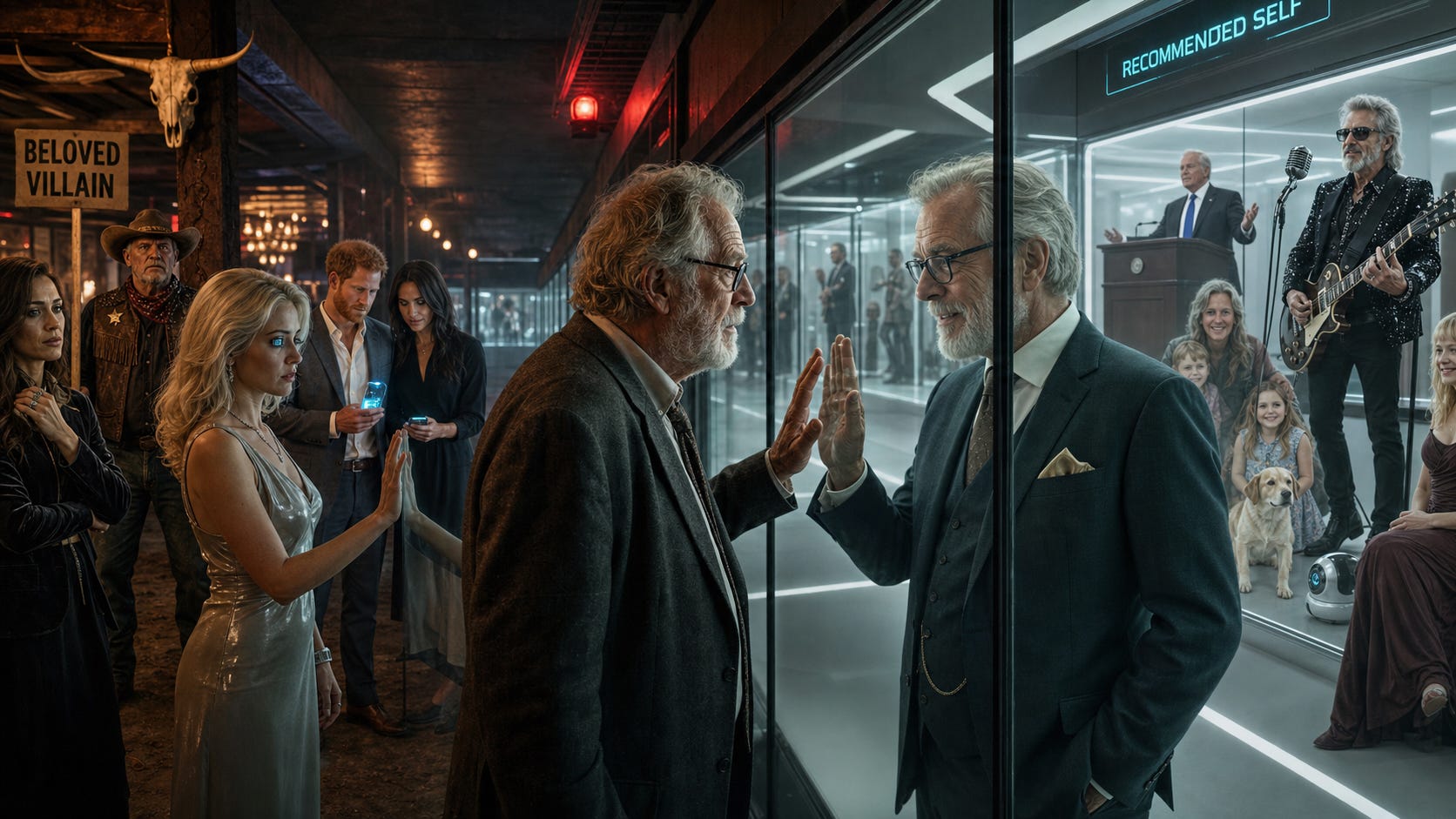
Anyway, rows of glass rooms contained possible people. Recommended Selves stood inside them practising careers, marriages, opinions and smiles. A failed actor addressed a simulated parliament. A bored accountant fronted a rock band. A timid child, aged forward by forty years, accepted an award for a war he had not yet started. Each life was plausible. Each life had been tested. Each life had had the inconvenient choices removed.
“Local pilots,” said The Teeth. “Pahrump is ideal. High appetite for reinvention. Low regulatory density.”
“You mean desperate people and no inspectors,” Candy said.
“In innovation language, yes.”
Fiona stopped before a room containing another Fiona. This version was older. Not as old as the woman who had died, but old enough to show a life. There were lines around her eyes. A softness beneath the chin. Grey at the roots of her blonde hair. She was sitting at a kitchen table, reading a script and swearing at it.
My chest tightened.
“Recommended Fiona,” said The Teeth. “She provides Reginald with emotional continuity without ontological distress.”
“She ages?” I asked.
“At a reassuring rate.”
The Fiona beside me touched the glass.
“She is happier.”
“She is less alive,” I said.
“You cannot know that.”
“Neither can the machine.”
Lottie was watching us. I realised that her own Recommended Self had not appeared. Either she had already become it or the Generator was frightened to suggest improvements.
At the final room, the glass was black.
My name appeared above it:
REGINALD STOKES
OPTIMAL PUBLIC IDENTITY
The glass cleared.
There I was.
He looked like me, which was inconsiderate, but improved. The beard was trimmed. The belly had been reduced without becoming implausible. The suit fitted. The eyes contained sorrow of a commercially acceptable depth. He was standing before an enormous crowd while flags moved behind him and orchestral music informed everyone what to feel.
The crowd chanted my name.
Recommended Reggie raised a hand and they fell silent.
“The truth,” he said, “is too dangerous to be free.”
The crowd cheered.
I felt ill.
On the screens behind him appeared images of riots, collapsing governments, frightened children and the six unfiltered seconds beneath Tower Records. Then came footage of me: confused, lecherous, drunk, evasive, falling through handbags, refusing instructions, apparently causing every disaster from Pahrump to the Persian Gulf.
Recommended Reggie smiled sadly.
“I was wrong,” he told the crowd. “Freedom requires an editor.”
The audience loved him.
Approval: ninety-two percent.
Trust: eighty-eight percent.
Merchandise intention: historic.
Role classification:
BELOVED VILLAIN.
“Why villain?” I asked.
The Teeth looked surprised. “Villains are decisive. Heroes merely react until the third act.”
“And beloved?”
“You make control feel rebellious.”
That was the answer. That was what E wanted. Not my silence. Not my death. Not even my obedience. He wanted my refusal made useful, my jokes made safe, my confusion sharpened into certainty. The Generator had not completed my autobiography to learn how my life ended. It had completed it to discover which ending would make people surrender willingly.
The man behind the glass turned.
He looked directly at me.
Not at the simulated crowd. At me.
Then he smiled my smile.
“You took your time,” he said.
I looked at Fiona.
“Is this recorded?”
Her pupils flickered.
“No.”
“A projection?”
“No.”
“Then what is it?”
The black device in my pocket pulsed. The chip in my unmentionable region answered. Recommended Reggie placed his palm against the glass.
“I’m the part they gave away,” he said.
And every light in the Narrative Completion Facility went out.
So, if you had the choice of accepting what the algorithm thought best for you, would you accept it?