

MY DINNER WITH DESTINY
Success aint what it's cracked up to be

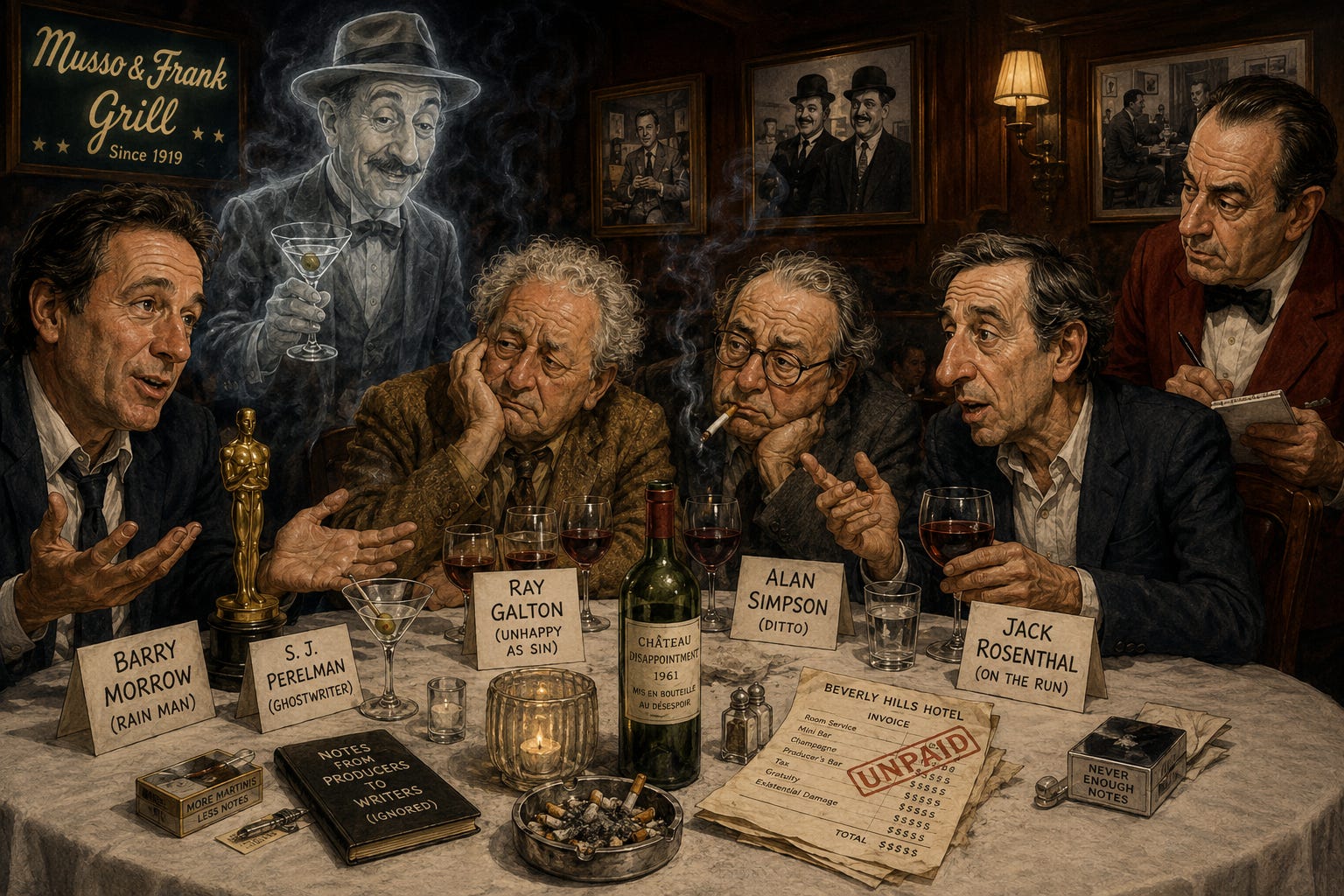
I once had dinner with Barry Morrow, one of the writers of Rain Man, at Musso & Frank Grill on Hollywood Boulevard. He had an Oscar, which in those days I regarded as proof that civilisation occasionally got something right. It was, and probably still is, a small golden idol before which ambitious screenwriters burned incense, self-respect and occasionally their first wives.
After a few martinis I asked him if winning an Oscar was as wonderful as it looked.
“It was,” he said, “For six minutes. Then the phone stopped ringing.”
Every producer now regarded him as “the Rain Man fellow”, which in Hollywood is rather like being introduced as “our leading authority on left-handed Albanian dentistry.” It means you’ve become internationally indispensable in one area nobody intends ever to visit again. Autism then was not a workable franchise unlike “Fast and Furious.” Nowadays I am sure that Rain Man 2 would become a diversity franchise where Rain Man teams up with an array of disabled demographics who develop super powers.
Similarly, though in London this time at the Institute of Contemporary Arts, I had drinks with Ray Galton and Alan Simpson. To me they were also gods. Steptoe and Son, Hancock’s Half Hour! Whatever Happened to the Likely Lads? TV brilliance!
To them, however, they were unpaid plumbers of other people’s plumbing. Alan who looked as though he had been assembled from spare uncles during a national shortage, said, “People think Hancock was this great genius. He was. But geniuses can be a right pain in the arse.”
Ray, who looked as if he had been requisitioned by the same hangover, said, “Half the time we weren’t writing jokes. We were writing Hancock’s moods.”
They told me that working on Steptoe and Son was like wrestling eels in a telephone box while someone from the BBC stood outside measuring the telephone box to see whether it could be made cheaper without affecting the quality of the eels. The BBC wanted relevance. The actors wanted respect. The network wanted two men in a room cheap. And we wanted a drink, said Alan, “preferably several.” And so, they had decided to move to France and retire and never write another script again. That resolution did not last, but enthusiasm had been knocked out of them.
On another occasion in a pub in Soho, I got talking to Jack Rosenthal who had written everything from Sunday Bloody Sunday to Yentel, where he had got bogged down in endless rewrites to suit Barbara Streisand’s whims of the moment. Each revision pleased her more, as it gave her more to do and others less, though it is hard to know which of those pleased her most.
Jack maintained every revision made the script worse. Barbara, naturally, thought precisely the opposite. This is one of the occupational hazards of writing for stars. The audience, according to the star, has purchased a ticket to see Barbara Streisand. The screenplay is merely there to stop her bumping into the scenery.
He told me about once being on a production where he was put up in a very expensive hotel where he was supposed to be working on the script. Then he heard from his agent that the company had gone bankrupt and that he had better make a run for it. There are many glamorous images associated with successful screenwriters. His fleeing through the lobby in the dead of night with a back pack and in those day, a typewriter, before someone presented him with the producer’s bar bill is not generally among them.
Then the ghost of S.J. Perelman visited me in a dream. His eyebrow entered the room several moments before the rest of him, pausing only to inspect the drinks cabinet. “You boys think you’ve suffered?” he said, “Try working for the Marx Brothers. They demanded jokes that made no sense whatsoever. Naturally I supplied them. They rejected them for being insufficiently irrational. The producers on the other hand, my boy, have always wanted originality, provided it bears a striking resemblance to something that made money last Thursday. Writers are ground to dust between them.”
He sipped his invisible martini. Stirring it occasionally with an invisible olive on an invisible cocktail stick.
I woke the next morning feeling curiously optimistic. After all, if an Oscar winner, the creators of Steptoe and Son, Jack Rosenthal and the ghost of S. J. Perelman all believed success was merely another form of organised disappointment, it occurred to me that my dismal career was normal and that there are only two kinds of successful writer. Those who haven’t yet discovered why they’re miserable, and those who are kind enough to explain it over dinner. It is the nearest thing our profession possesses to peer review.
Why not tell me about your disappointing success?
a very interesting perspective
I really enjoyed the dry humor throughout.