

PM, Batteries not included
The question is, how long does the battery last with these Prime Ministers?

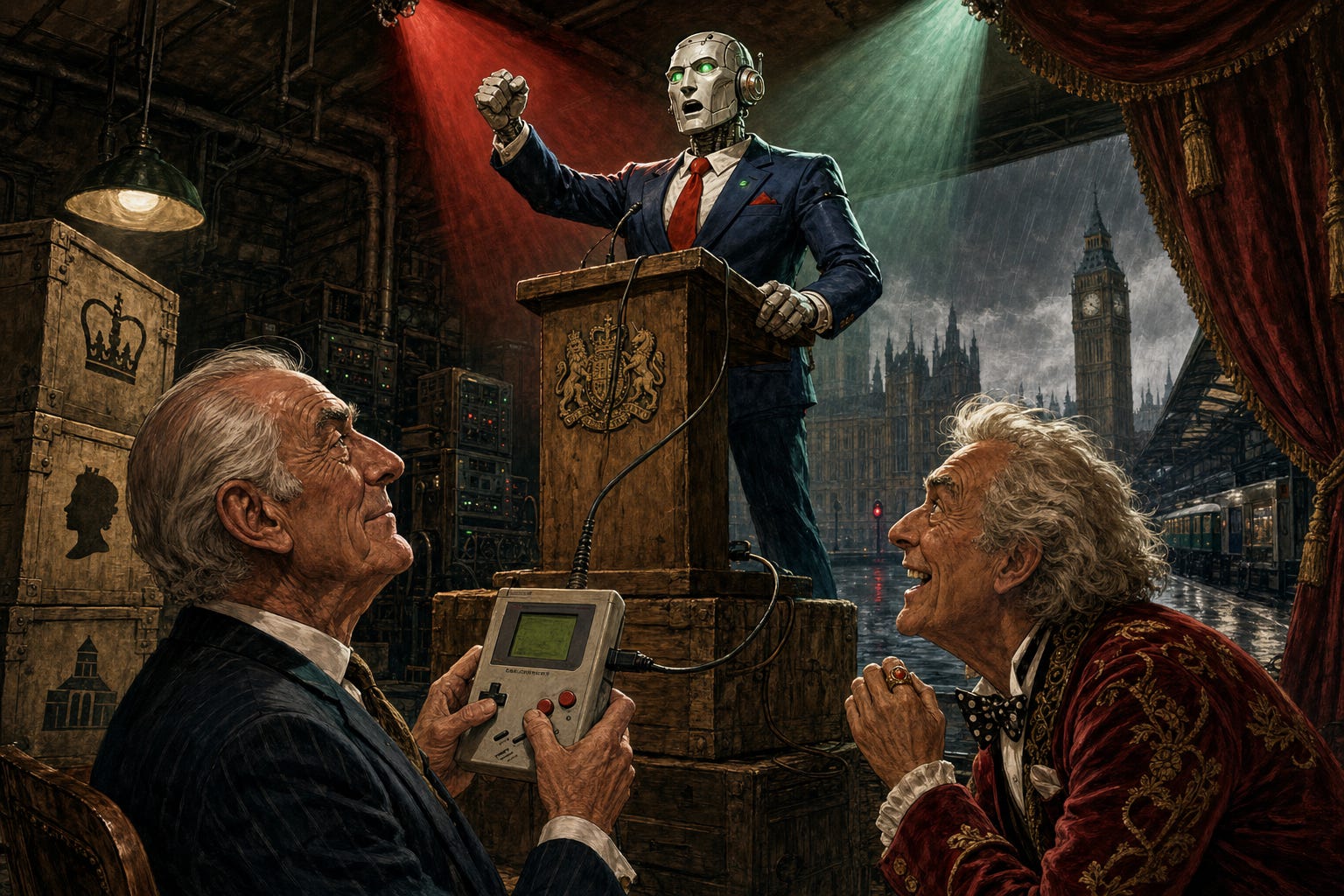
Sir Nigel had always believed democracy would be greatly improved if it could be switched off at the wall. This was not, he felt, an authoritarian position. It was electrical safety.
The machine stood beneath a dust sheet in Sub-Basement Four of the Cabinet Office, between a crate marked EMERGENCY MONARCH—INFLATABLE and three hundred thousand commemorative mugs bearing the face of a Prime Minister who had resigned before they reached the kiln.
Algie pulled away the sheet.
“Good God,” said Sir Nigel.
“Rather handsome, isn’t he?”
The robot was six feet two, broad in the shoulder and narrow in the polling data. Its face had the polished, approachable blankness of a man who had spent twenty years agreeing with whatever had just been said to him. It wore a navy suit, a white shirt and a red tie of such disciplined redness that it appeared to have been approved by a focus group. Where its heart ought to have been, a little green light blinked beneath the words PROPERTY OF THE MINISTRY OF MANAGED EXPECTATIONS.
“What is it?” Nigel asked.
“The Automatic Regional Statesman,” said Algie. “Northern voice package. Municipal conviction engine. Industrial-strength pointing finger. They commissioned him after somebody discovered that voters prefer politicians who appear to believe things.”
“A dangerous innovation.”
“That is why they cancelled it.”
Around the robot’s neck hung a grey cable. At the other end was an ancient Nintendo Game Boy, yellowed with age, its battery compartment held shut by House of Commons headed notepaper and Sellotape.
Nigel lifted it with reverence. “Surely this belongs in a museum.”
“It did. The museum was privatised.”
On the screen, blocky letters appeared:
SELECT PLAYER
1. STATESMAN
2. MAN OF THE PEOPLE
3. RELUCTANT SAVIOUR
4. OTHER—PLEASE SPECIFY REGION
Algie pressed START.
The robot’s eyes opened.
“My friends,” it said.
Nothing else happened.
Algie pressed the A button.
“My comrades!” the robot roared, throwing both arms into the air with such violence that a civil-service fire extinguisher surrendered from the wall. “My bewildered commuters standing on Platform Four wondering where the 8:17 has gone!”
Nigel’s eyebrows rose. This was, for him, the equivalent of a standing ovation.
The robot mounted a crate of obsolete manifesto commitments and addressed the empty basement as though it contained a million angry people and one television camera.
“People say politics is broken. Broken? BROKEN? This country isn’t broken! It’s held together with gaffer tape, wishful thinking and a bloke called Dave who’s been repairing the same pothole since the Blair administration!”
“Excellent projection,” Nigel murmured.
“They used the lungs from a decommissioned air-raid siren,” said Algie.
“They tell us to be sensible. I reject sensible! Sensible gave us meetings! Sensible gave us consultation documents! Sensible gave us replacement bus services!”
Nigel glanced at the Game Boy. A tiny bar labelled RIGHTEOUS INDIGNATION had filled to sixty-three per cent.
“I want trains that arrive before their passengers retire!
“I want buses that turn up more often than elections!
“I want councils with enough money that the phrase ‘doing more with less’ is punishable by being forced to attend a three-hour procurement seminar!”
“Bit severe,” said Nigel.
“We can commute it to two hours for a first offence.”
The robot punched the air. A small panel opened in its wrist and printed a fully costed transport strategy. Algie caught it before it hit the floor, glanced at the first page and put it discreetly in his pocket.
“And don’t tell me it can’t be done! Every year somebody manages to organise Glastonbury, Wimbledon and Eurovision, yet somehow getting from Bolton to Bury requires the strategic planning of the Normandy landings!”
Sir Nigel began to pace around the machine. “Does it answer questions?”
“Not if it detects a journalist.”
“Remarkable.”
“We’ve become a nation of apologising. ‘Sorry for the delay.’ ‘Sorry the website’s down.’ ‘Sorry we’ve accidentally privatised gravity.’”
The robot leaned forward, eyes blazing municipal blue.
“NO! I refuse!”
The lights went out.
For three seconds the basement was dark except for the Game Boy screen and the green glow inside the robot’s chest.
“Was that meant to happen?” Nigel asked.
“The National Grid is means-tested.”
Emergency lighting coughed into life. The robot had not moved.
“I dream of a Britain where the ticket machine works. Where the lift at the station works. Where the escalator works. In fact, I’d settle for one thing working at a time!”
Somewhere in Whitehall, as if stung by the remark, a printer jammed.
“People say I’m too ambitious.
“Too ambitious?
“Napoleon was ambitious. Brunel was ambitious. The bloke who invented contactless payment was ambitious. I merely want Manchester to have a tram that doesn’t announce ‘We apologise for the inconvenience’ as though it’s reading out its own last rites!”
Algie wiped away a tear. “He makes one proud to have misplaced one’s railcard.”
Nigel took the Game Boy and experimented with the D-pad. He pressed left. The robot’s accent moved six miles towards Wigan. He pressed right. It returned by way of a television studio in Salford. Up increased hope. Down blamed Westminster. SELECT caused it to remove its jacket and roll up its sleeves.
“So let us march forward—not literally, it’s raining—but metaphorically!”
“Weather-responsive,” Nigel said. “That alone puts him ahead of most cabinets.”
“Let us build things again!
“Let us fix things again!
“Let us remember that government exists not to produce impressive PowerPoint presentations, but to stop ordinary people screaming into paper bags every Monday morning.”
Nigel stopped pacing.
For a moment even he looked moved. It was a very small movement, barely detectable without military optics, but it occurred.
“Together we shall conquer bureaucracy!
“Together we shall defeat malfunctioning ticket barriers!
“Together we shall stare down the self-checkout that insists an unexpected item has appeared in the bagging area!”
The robot flung out an accusing finger. Across London, seven self-checkouts immediately summoned an assistant.
“Forward!
“Onward!
“To the glorious revolution of things actually working!”
It held the pose. Its chest light pulsed. A fan whirred somewhere behind its tie.
Then, softly, with the tragic bewilderment of a hero abandoned by the timetable, it said:
“…Now, where’s my train?”
Silence filled the basement.
Algie began to clap.
Sir Nigel joined him.
They applauded until the robot bowed, misidentified the fire extinguisher as a regional newspaper and promised it an integrated transport settlement.
“Prime-ministerial,” Nigel said at last.
“Substitute prime-ministerial,” Algie corrected. “That was the original brief. In the event of illness, scandal, rebellion, personality or the discovery of a firm belief, the machine takes over until a human can safely be found.”
“And we control it entirely from this?” Nigel held up the Game Boy.
“Every policy, gesture and emotional register. B makes him compassionate. A makes him furious. Both together announce a task force. If you enter the Konami code, he nationalises the railways.”
Nigel stared at the controller.
“Can he survive Prime Minister’s Questions?”
“He has three hundred and twelve pre-loaded ways of saying the last government left a mess.”
“Foreign affairs?”
“He can recognise France from a photograph.”
“The economy?”
“He knows there is no money.”
“Good Lord,” said Nigel. “He’s overqualified.”
The robot waited patiently, still smiling at the fire extinguisher.
Nigel’s gaze travelled past it to the darkness at the end of Sub-Basement Four, where more dust sheets stood in two neat rows. Algie followed his eyes.
“How many?” Nigel asked.
“This is the only completed prototype.”
“But how many could we make?”
Algie smiled. It was the smile he wore whenever constitutional equilibrium was about to require maintenance.
“How many constituencies are there?”
They walked between the covered shapes. One was labelled SHADOW CHANCELLOR—SOLAR POWERED. Another, DEPUTY LEADER—DO NOT PLACE NEAR MICROPHONE. At the far end stood an assembly unit designed during a period when Britain still manufactured things and had not yet realised this was inefficient.
Nigel ran a finger through the dust.
“The whole Labour Party,” he said thoughtfully.
“Front bench and back bench?”
“Naturally. One should not automate inequality.”
“The unions may object.”
“Give them a controller.”
“There’s only one controller.”
Nigel looked down at the Game Boy. The plastic was scratched, the screen green, the red buttons worn smooth by the thumbs of vanished children. In his hands it had the gravity of the nuclear case and considerably better battery life.
“Then we shall retain it,” he said.
Algie uncovered the assembly unit. A brass plate read:
BRITISH AUTOMATIC GOVERNMENT WORKS
ONE NATION AT A TIME
“Imagine it,” Algie breathed. “An entire parliamentary party that keeps to message, arrives charged and can be reset with a paperclip.”
“No briefings against one another.”
“No memoirs.”
“No leadership contests.”
“Unless we select multiplayer mode.” They both shuddered.
Behind them the substitute Prime Minister stirred. Its head turned with a faint servo whine.
“My friends,” it began again.
Nigel pressed PAUSE.
The robot froze with one fist raised, hope arrested at the point of delivery.
“We must proceed carefully,” Nigel said. “The British people will accept almost any alteration to their constitution provided nobody explains it and the box has been ticked.”
Algie nodded. “Pilot scheme?”
“Manchester first. If anyone notices, call it devolution.”
They switched off the basement lights and climbed the stairs, taking the Game Boy with them.
In the darkness, the machine remained upon its crate, fist raised towards a future in which trains arrived, escalators worked and the government could be restarted by removing the batteries and blowing on the contacts.
Somewhere deep inside it, a tiny electronic voice whispered:
“Sorry for the delay.”
This is a very interesting read! Im very happy that you sent this to me. Keep writing and sharing your stuff with me! And I would add that your theme for Substack is very appealing!